

![[object Object]](https://cdn.livebid.cz/authors/5655.jpg?v=3)
Základní údaje
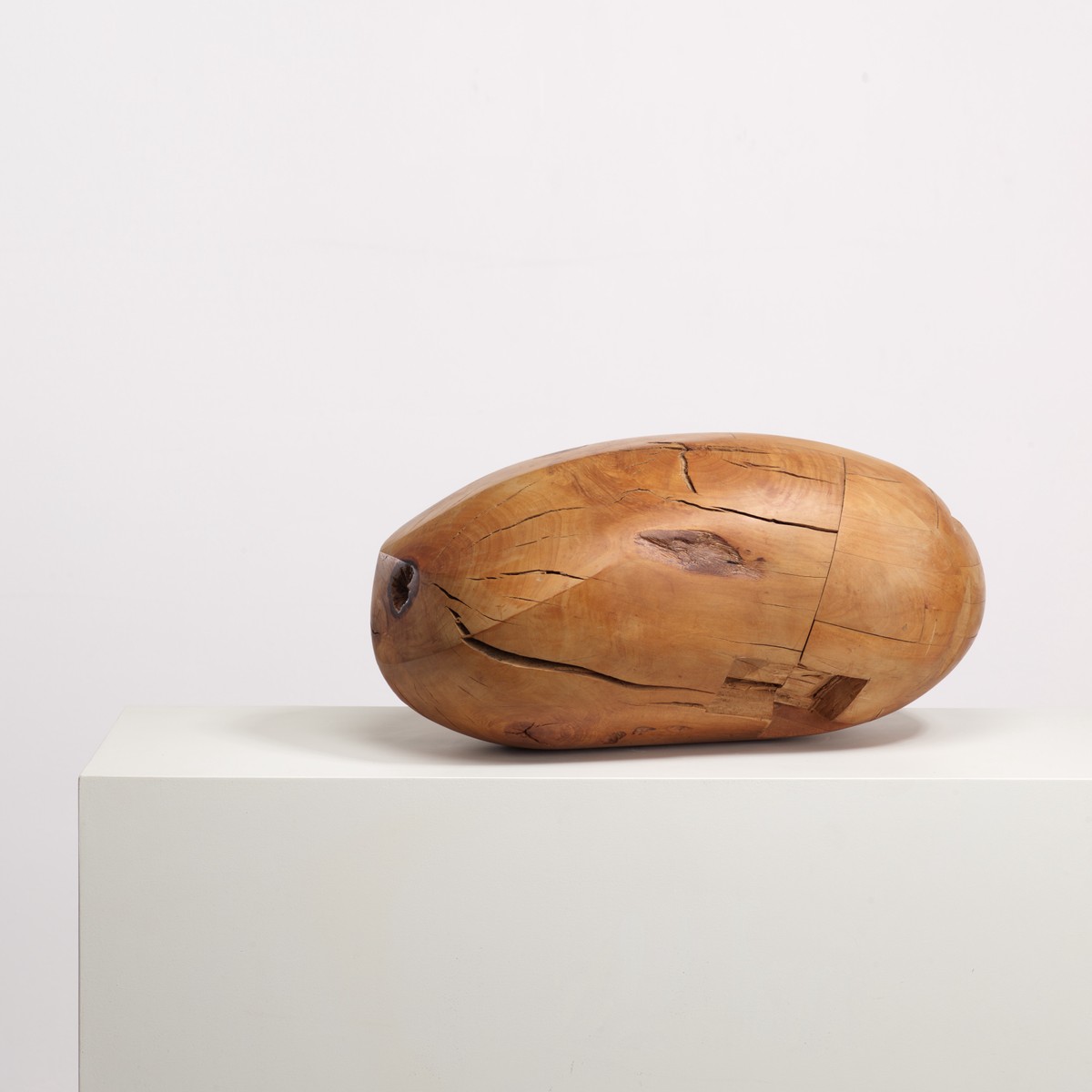
| technika | jabloňové dřevo |
| rozměry | 26 × 53 × 28 cm |
| rok | 1994–1995 |
Popis
EXHIBITED
Anonymní forma čtverce, Fait Gallery, Brno 2023 Příroda nespěchá, Etcetera Art, Praha, 2023
LITERATURE
Arsén Pohribný: Klub konkrétistů, KANT in collab with Arséne Pohribný and Oblastní galerie v Jihlavě, České Budějovice, 1997, p. 49.
When Jiří Hilmar, together with Tomáš Rajlich, Radoslav Kratina, Miroslav Vystrčil and the theoretician Arsén Pohribný, founded the Concretists' Club in 1967, his work was anchored in the field of kinetic objects and especially optical paper reliefs. He had his first solo exhibition (at the Fronta Gallery in Prague, 1967) and was respected as a poster maker. After emigrating, he developed his artistic vision first in Frankfurt am Main and Munich, and from 1974 in Gelsenkirchen at the art settlement Die Künstlersiedlung Halfmannshof, where he worked until 2013.
During the 1970s, Jiří Hilmar began to use other materials besides paper and cardboard, in particular clay, cord, felt, concrete and above all wood, exploiting their qualities of meaning and gradually arriving at a loosening of the rectangular system, its distortion and softening. At that time, the artist moved from his studio in the middle of virgin nature in Inning am Ammersee near Munich to Gelsenkirchen, located in the heart of the industrial zone in the Ruhr area. The devastated landscape there led the artist to reflect ever more deeply on the threat to nature posed by technical civilisation. Humanity's growing desire for world domination was the main concern that prompted Hilmar's understanding of the role of earthly and cosmic balance and his conviction that life on earth could only be preserved if the broken belonging between nature and man was restored.
In this context, Jiří Hilmar began to create wooden objects based on the idea that wood is an autonomously growing material that creates itself and also forms itself, so that the object formed from it becomes a fragment of the great principle of natural processes and laws. He was fascinated by the idea that it was possible to work like nature and to live with its processes, but with respect for its order and inner energy. He therefore wedged the wooden slats cut from the tree trunk into a new whole, fascinated by the process of transforming the individual labile slats into a coherent stable block, which in some cases he overlaid with layers of kaolin. At other times, he split the growing log in half, completing the missing part with wooden slats and sanding it into the shape of a fruit (Plod, 1994-1995). In both of these works, the final smoothing of the surface became the conclusion of the creative process, but also a fragile reference to the moment when the principle of creation merged with the principle of nature and the two forces entered into mutual harmony.
O autorovi
Jiří Hilmar se narodil 28. května 1937 v Hradci Králové.
V letech 1952-1956 studoval na Střední průmyslové škole bytové tvorby v ateliéru prof. Richarda Pípala, kde se formovala jeho tvorba, začínající realistickým přístupem a postupně se orientující k matematické přesnosti a geometrii.
Po studiích se věnoval užité grafice, zejména tvorbě filmových plakátů a knižních obálek, což mu vyneslo odborný respekt. V roce 1967 byl spoluzakladatelem Klubu konkrétistů.
Politické důvody ho v roce 1969 přiměly k emigraci do Spolkové republiky Německo, kde žil až do roku 2013 a věnoval se volnému umění, sochám a reliéfům. Jeho dílo prošlo řadou směrů a stylů, od optických témat k prvkům arte povera.
V roce 2013 obdržel čestné občanství Hradce Králové a vrátil se natrvalo do Česka. Hilmarovo dílo je zastoupeno v předních institucích a byl oceněn několika desítkami autorských výstav.
