Popis
1910
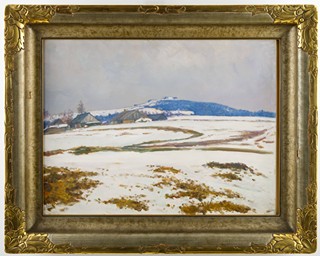
Oil on paper, 53×40 cm (53.5×66 cm). Marking: signed in pencil lower right "Kaván". The work is set in the original, author`s carved frame with silvered and gilded profile and a delicate vegetal décor in the corners. The reverse of the frame is sealed with a screwed plywood panel, which bears two exhibition labels and one provenance label.
"Hradiště in Winter" from 1910 represents a highly authentic and exceptionally valuable collector`s document of the peak creative period of František Kaván, in which the artist definitively abandons Symbolist melancholy and fully returns to pure Realism imbued with a deep feeling for the Czech landscape. The location at Přední Hradiště near Vítanov, which became Kaván`s fated retreat after his second return to the Highlands (1909), is not a mere topographical detail but a manifesto of the artist`s sense of belonging to the harsh yet picturesque character of the Hlinsko region. The technique of oil on paper was for Kaván an ideal medium in this period for immediate plein-air recording, enabling him to capture fleeting atmospheric changes with brilliant ease and speed. The style of the painting is characterised by a confident, almost impressively liberated facture, where the artist does not use colour for mere description but for the building of mass and space. The palette is constructed on a superbly composed interplay of cool valeurs of white, bluish and grey, which in the foreground contrast with the ochre and earthy tones of emerging vegetation and the brown of rural buildings, thereby creating a plastic impression of thawing and the specific humidity of winter air. The composition, with the diagonal of the road leading the viewer`s eye toward the horizon of the dominant Hradiště hill, demonstrates the artist`s sensitivity to monumentality even in an intimate format. The exceptionality of this particular piece is underscored by its unquestionable provenance and exhibition history, documented by labels from the key Jubilee Exhibition in Hlinsko in 1941 (cat. no. 21) and the prestigious retrospective Výtvarné Hlinecko 1962 (cat. no. 107) held under the scholarly auspices of the National Gallery in Prague, making the work a first-rate gallery item with exceptional collector`s potential.
Condition A.
Exhibited:
Catalogue of the Jubilee Exhibition of Works by Master František Kaván for his 75th birthday in Hlinsko, Hlinsko: Municipal Museum in Hlinsko 1941, cat. no. 21.
Anna MASARYKOVÁ (ed.): František Kaván a Českomoravská vysočina, Hlinsko: Osvětová beseda v Hlinsku – Národní galerie v Praze 1962, cat. no. 107.
Provenance: Klement Bouška, Hlinsko; Collection of Dr Boček, Brno.
O autorovi
František Kaván se narodil 10. září 1866 ve Víchovské Lhotě. Po maturitě se rozhodl pro studium malířství na pražské Akademii výtvarných umění, kde studoval v krajinářském ateliéru pod vedením Julia Mařáka. Během svých studií se vyznačoval zaměřením na barvu a přikláněním se od náladovosti k realitě.
Byl významným českým malířem-krajinářem, ale také básníkem a překladatelem z ruštiny. Ve svém díle zachycoval především krajinu rodného kraje, zejména Krkonoše, Českomoravskou vrchovinu a Železné hory. Po realistickém začátku se v letech 1895–1899 přikláněl k symbolismu, avšak po roce 1900 se opět vrátil k čisté krajinomalbě s impresivně laděným realismem. Byl známý především svými zimními motivy.
František Kaván si během své kariéry vybudoval renomé jednoho z nejdůležitějších českých krajinářů, vedle jmen jako byli Otakar Lebeda a Antonín Slavíček. Jeho díla jsou dnes mimo jiné zastoupena ve sbírce pražské Národní galerie.
V osobním životě se František Kaván oženil dvakrát. Poprvé v srpnu 1896 s Helenou Váňovou, která byla jeho životní oporou až do své smrti v roce 1926. Poté, v květnu 1930, se oženil s Pavlínou Šírovou, vdovou po pardubickém malíři Janu Šírovi.
František Kaván zemřel 16. prosince 1941 v Libuni, kde je také pochován.



![[object Object]](https://cdn.livebid.cz/authors/7543.jpg?v=3)
