



Základní údaje
| technika | oil on wood |
| rozměry | 103.5 x 79 cm |
Popis
The ‘Master of the Prodigal Son’ is the Notname given to an important Flemish painter and designer of tapestries and stained glass. The Belgian art historian Georges Hulin de Loo invented the Notname after one of the master’s best-known works depicting The return of the prodigal son at the Kunsthistorisches Museum in Vienna. The artist was active in Antwerp where he must have operated a large workshop between c. 1530 and c. 1560. He painted religious subjects, landscapes, genre scenes and allegories
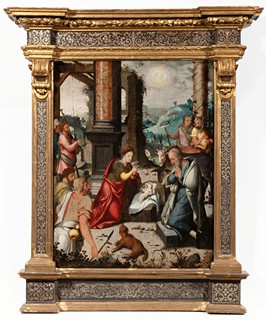
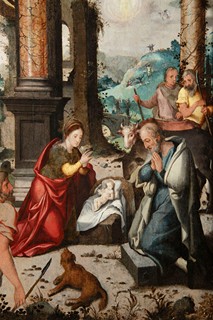
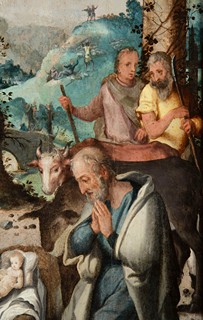
In a ruin with large, antique marble columns, the infant Jesus lies on straw and a white cloth on a stone plinth and is being adored by his parents. Mary is kneeling on the left in a red cloak and St Joseph is kneeling on the right in a blue robe and grey cloak. The shepherds hurry in from all sides. Two bearded men enter the picture from the front left. Further back on the left edge of the picture is a shepherd with a bagpipe and two more shepherds can be seen on the right behind the ox and the donkeys. The Annunciation to the shepherds can be recognised in the landscape in the background. A shepherd dog has already settled down in the foreground and is looking at Mary. Its well-captured pose lends the composition a realistic, lively element. The ruin is overgrown with vegetation, which the painter has rendered with great delicacy. The lower edge of the picture is framed by a ‘border’ of detailed plants that stand out against the light-coloured ground. Oil on panel , 103.5 × 79 cm . Accompanied by certificate written by Prof. em. dr. Paul Vandenbroeck
Katholieke Universiteit Leuven
