Základní údaje
| rok díla | 1964 |
| technika | olej, plátno |
| rozměr | 120 x 100 cm |
| signatura | sign. vpravo dole: F. Muzika 64 |
Popis
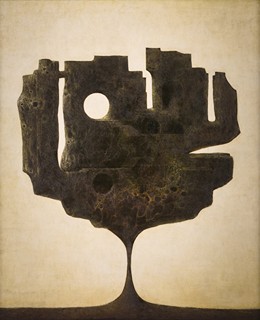
From the expert opinion of PhDr. Rea Michalová, Ph.D.: "The painting 'Elsinor V' is unquestionably an authentic, exclusive, profoundly imaginative, and fateful symbolist work by František Muzika, a leading figure of the Czech avant-garde and an artist who belongs to that rare group of creators 'who are not forgotten, because through the quality of their work, their example, and their personal influence, they touched and influenced everyone they could reach' (M. Hegar). From this perspective, the year 1964 was significant, as Muzika was represented at the international exhibition of the avant-garde movement Phases in Brussels and at the 32nd Venice Biennale. Building on the success of the latter exhibition—which included the painting under consideration here, where admirers of Surrealism from the Netherlands “fell in love” with it, and in whose family it has remained to this day—he subsequently held solo exhibitions in Milan (where “Elsinor V” was also presented) and in Venice as well. “Elsinor V” unmistakably refers, through its name and layout, first and foremost to Hamlet’s impregnable fortress, which has long symbolized the indomitable spirit, a place of perfect mental concentration and integration. Depicted in a phantom-like manner, the object is thus not merely a weathered stone ruin, but also appears as a gigantic stone cup, a prehistoric or totemic object; this association arose from the artist’s effort to express, through visual means, the myth of the creation of irrational symbols in which the spiritual essence of both ancient and modern times would be concentrated. In the painting “Elsinor V,” František Muzika, on the threshold of old age and persistently posing questions about the meaning of human existence, has created an evocative, imaginative monument to ancient cultures, whose caves and corridors are the last, forgotten traces of a vanished life.”
Listed in the artist’s catalog, no. 835
Provenance: until now, a private collection in The Hague, Netherlands – purchased at the 32nd Venice Biennale in 1964
Exhibited: Exhibition of Paintings by František Muzika from 1920–1964, Regional Gallery in Hradec Králové, June 7–July 5, 1964, cat. no. 100
Exhibition of Paintings by František Muzika from 1920–1964, Regional Gallery in Liberec, July 19–August 16, 1964, cat. no. 100
32nd Venice Biennale, Italy, 1964
František Muzika, Galleria de Naviglio, Milan, Italy, March 6–16, 1965
František Muzika or The Imagination of a Lyrical Order, Arcent-rum, Prague, 1966, cat. no. XX
Reproduced in: (monograph) František Šmejkal, František Muzika, Odeon, Prague, 1966, ill. 167
František Muzika, Galleria de Naviglio, Milan, Italy, March 6–16, 1965, text in the catalog by the prominent Italian art historian Enrico Crispolti, reproduced opposite the introductory text
O autorovi
František Muzika (26. června 1900, Praha – 1. listopadu 1974, Praha) byl významným českým malířem, ilustrátorem, typografem a scénografem. Jeho umělecká dráha se odehrála v širokém spektru uměleckých odvětví, a to od malby a ilustrace až po scénografii.
Studoval na Akademii výtvarných umění v Praze v letech 1918–1924 pod vedením profesorů Jakuba Obrovského, Karla Krattnera a Jana Štursy. Poté pokračoval ve studiu na Académie des beaux-arts v Paříži v letech 1924–1925. Tento bohatý akademický základ mu umožnil vyvinout pestrou škálu dovedností.
František Muzika se stal výraznou postavou v uměleckém hnutí Devětsil a následně se připojil k SVU Mánes a Nové skupině. Jeho umělecký rozhled byl značně široký – pohyboval se od kubismu přes surrealismus až k abstrakci. Jeho dílo bylo ovlivněno lyrickým kubismem, magickým realismem a neoklasicismem.
Jeho přínos v oblasti scénografie byl značný – navrhl více než 100 výprav, z nichž 43 byly realizovány pro Národní divadlo v Praze v letech 1927–1947. Tím se stal klíčovou postavou ve vývoji divadelního prostředí.
Vedle scénografie a malby se věnoval i ilustraci, typografii a užité grafice. Jeho ilustrace spojují technickou preciznost s imaginativními náměty. Jeho typografická tvorba byla ovlivněna avantgardními trendy, přičemž často uplatňoval prvky nové typografie.
František Muzika zemřel 1. listopadu 1974 v Praze, zanechav po sobě bohaté dědictví v podobě pestrobarevného uměleckého odkazu, který odráží jeho širokou paletu uměleckých zájmů.




![[object Object]](https://cdn.livebid.cz/authors/11244.jpg?v=2)
