
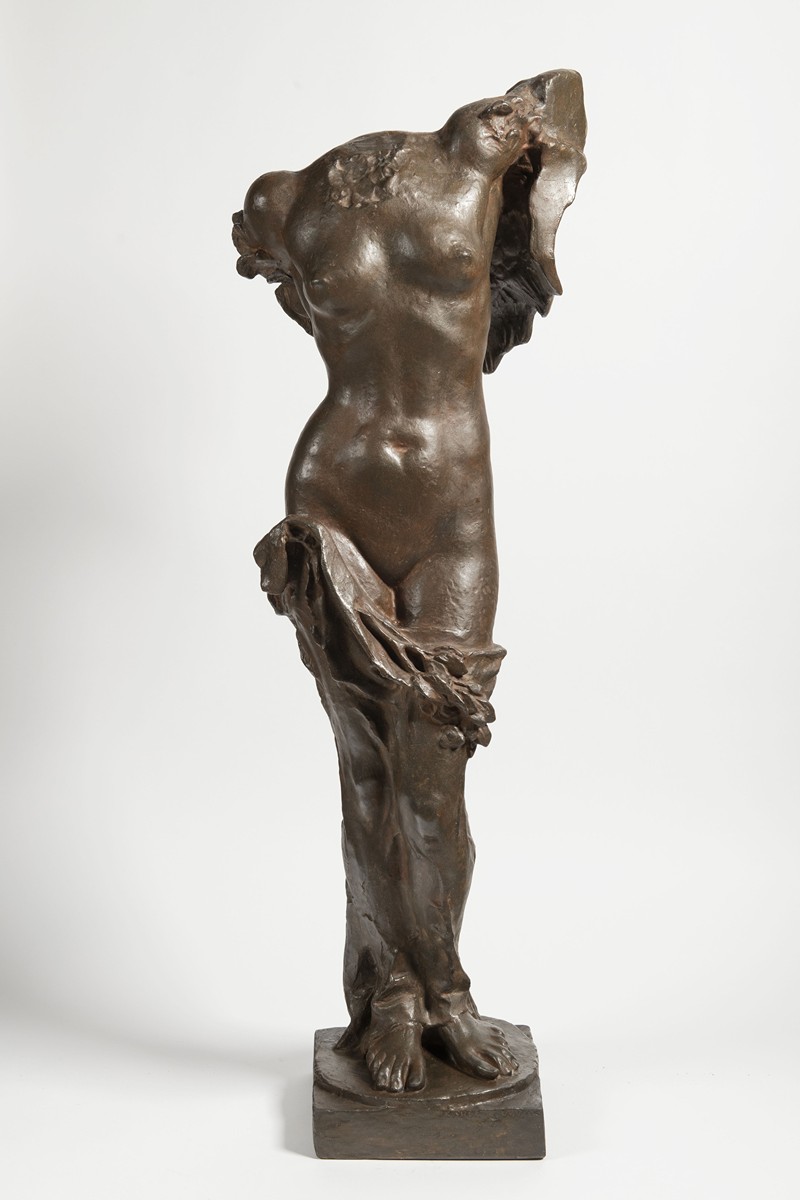


Základní údaje
| rok díla | 1943 |
| rozměr | 100 cm |
| materiál | patinovaná sádra |
| signatura | sign. na plintě: KAREL DVOŘÁK / 1943 |
Popis
Karel Dvořák belonged to a prominent generation of sculptors who had a profound influence on the development of Czech sculpture right up to the second half of the 20th century. He trained in figurative sculpture under Drahoňovský, Myslbek and Štursa. Classical sculpture was a major source of his inspiration, as evidenced by the layout of his early studio, which was filled with replicas of ancient sculptures from the Glyptothek in Munich. Whilst in the 1920s he drew inspiration from Renaissance sculpture and Gutfreund’s ‘civilism’, in the 1930s he turned towards an exalted Baroque style. This unique original plaster sculpture bears the characteristic features of his later work, particularly the torso-like conception of the figure, which can also be seen in works such as *Tragedy* (1938) and *Czech Rivers* (1938–1940).
O autorovi
Karel Dvořák byl český sochař narozený 1. ledna 1893 v Praze. Původně se vyučil cizelérství a poté studoval na Uměleckoprůmyslové škole v Praze v letech 1911–1913. Následně navštěvoval sochařství na Akademii výtvarných umění, kde byl žákem Jana Štursy.
Jeho studium na Akademii bylo přerušeno první světovou válkou, ale dokončil ho v letech 1917–1919 opět u profesora Štursy. V roce 1928 se stal profesorem na Státní uměleckoprůmyslové škole v Praze, kde působil až do své smrti v roce 1950.
Karel Dvořák byl členem Spolku výtvarných umělců Mánes v období 1919–1949. Jako sochař byl aktivní v období od roku 1919 do roku 1949, a jeho tvorba zahrnovala sochy různých témat.
Zemřel 28. února 1950 v Praze.
