Basic info
| rok díla | 1943 |
| technika | olej na kartonu |
| rozměr | 46 x 28 cm bez rámu, původní rám |
About
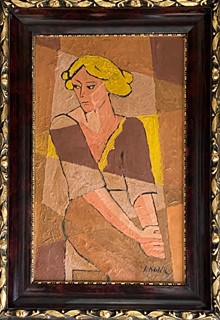
CURATOR'S TIP: An early work by Jan Kotík from the wartime period represents an exceptionally attractive collector's opportunity. Created in 1943, the painting dates from a period when the artist was developing his own visual language between Cubism, modern European art and Czech avant-garde traditions. Works from this early phase appear only rarely on the market. This Cubist Portrait of a Woman is documented by an original inscription on the reverse dated 1943. The composition depicts a seated female figure built from geometric planes and strong contours characteristic of Cubist-inspired expression. A restrained palette of ochres, browns, pinks and yellows creates a harmonious and sophisticated visual effect. The bold black outlines unify the composition and emphasize its structural strength. Despite its stylization, the work retains psychological depth and a contemplative atmosphere. Jan Kotík later became one of the most important figures of Czech post-war modern art, and his works are represented in major public collections. The painting is signed lower right and bears a period inscription on the reverse including the note "Photographed on 15 December 1947" and inventory marking "J. Kotík No. 43, 1947", documenting the work's post-war registration and early provenance. Coming from a private collection and preserved in its original frame, it offers collectors a rare opportunity to acquire an authentic example of the artist's early figurative period.
Author
Jan Kotík se narodil 4. ledna 1916 v Turnově. Byl významný český malíř, grafik, průmyslový výtvarník a pedagog. Studoval na Uměleckoprůmyslové škole v Praze pod vedením profesora Jaroslava Bendy. Ve čtyřicátých letech byl členem Skupiny 42. Jeho otcem byl malíř Pravoslav Kotík. V průběhu své kariéry byl Jan Kotík známý svými postkubistickými, konstruktivistickými a geometrickými díly. Tvořil také kaligrafické obrazy v kontrastních tónech černé a bílé. Zúčastnil se Světových výstav, jako byla Expo 58 v Bruselu a Expo 67 v Montrealu. Po invazi sovětských vojsk do Československa v roce 1969 odešel do Západního Berlína a později působil jako pedagog na Hochschule für Gestaltung v Ulmu. V roce 1979 byl zbaven československého státního občanství. Do Československa se vrátil v roce 1989 a krátce působil jako externí docent na Akademii výtvarných umění v Praze. Zemřel 23. března 2002 v Berlíně.



![[object Object]](https://cdn.livebid.cz/authors/8327.jpg?v=3)
