Basic info
| Technika | kombinovaná technika na papíře |
About
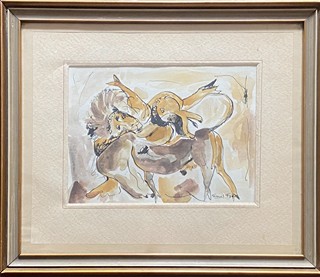
An exceptionally expressive figurative work by Emil Filla, thematically connected with one of the most important subjects of the artist’s mature oeuvre. Filla began developing his celebrated Fights and Struggles cycle in the second half of the 1930s, using classical heroes, fighting animals and dramatically intertwined figures to explore conflict, physical strength and resistance. In the present work, several human and animal forms are compressed into a single dynamic pictorial organism. Bodies overlap and penetrate one another, creating an almost centrifugal movement. Vigorous dark lines establish the basic structure of the composition, while freely applied brown, ochre and grey areas model the individual forms and reinforce their physical interaction. The combination of forceful drawing and spontaneous painterly passages gives the work remarkable immediacy and expressive intensity. For Filla, the motif of struggle extended far beyond the depiction of a dramatic scene. Throughout this important thematic area he repeatedly explored confrontations between humans and animals as well as animals fighting one another, developing related compositional ideas across painting, drawing, printmaking and sculpture. Emil Filla (1882–1953) was one of the central figures of Czech modern art and a founder of Czech Cubism. Painter, draughtsman, printmaker, sculptor and art theorist, he played a fundamental role in the development of the Czech avant-garde as a member of the Osma group, the Group of Fine Artists and the Mánes Association of Fine Artists. Of particular interest is the dialogue with the preceding lot #108, Theseus Carrying the Cretan Bull (Study). The two works explore Filla’s recurring theme of struggle through different artistic approaches and together provide a fascinating insight into his treatment of the interaction between human and animal forms. Signed lower right “Emil Filla”. Mounted, framed and glazed. Provenance: extensive private Moravian collection. The work is accompanied by an expert opinion prepared by PhDr. Michael Zachař, which is included with the auction lot. PhDr. Michael Zachař is a respected Czech art historian and specialist in Czech art of the 19th and 20th centuries. This expert assessment represents an important added value and provides significant support for the work's collector and investment standing. CURATOR’S TIP: A powerful and remarkably immediate work associated with one of Filla’s most important thematic areas. Its clearly legible signature and dialogue with lot #108 considerably enhance its collecting appeal. The accompanying expert opinion by PhDr. Michael Zachař represents another major collector attribute of the work. INVESTMENT RECOMMENDATION: Emil Filla remains one of the key and most sought-after figures of Czech modernism. Works associated with the Fights and Struggles theme occupy an important position within his oeuvre. The expressive composition, clear signature, distinguished provenance, relationship with lot #108 and accompanying expert opinion by PhDr. Michael Zachař make this an especially attractive collecting opportunity. The starting price is CZK 160,000.
Author
Emil Filla se narodil 3. dubna 1882 v Chropyni. V letech 1903 - 1906 studoval monumentální malbu na Akademii výtvarných umění v Praze pod vedením Vlaho Bukovace. Kvůli nespokojenosti s konvenčními metodami a náplní výuky školu opustil po třech letech. Ve svých raných letech byl Filla silně ovlivněn dílem Edvarda Muncha, a následně se přiklonil ke kubismu, který se v jeho díle začal projevovat od roku 1910.
Během své kariéry byl členem několika uměleckých skupin. Nejprve se stal členem skupiny Osma, s níž vystavoval v letech 1907 a 1908. V roce 1909 se přidal ke Spolku výtvarných umělců Mánes, kde setrval – s výjimkou období působení ve Skupině výtvarných umělců mezi lety 1911 – 1914 – až do své smrti.
V roce 1945 byl jmenován profesorem na Vysoké škole uměleckoprůmyslové v Praze. Během svého života se věnoval nejen malbě a grafice, ale také sochařství a teorii výtvarného umění. Byl také spoluredaktorem Volných směrů a formoval směřování českého kulturního dění především v meziválečném období. Jeho raná tvorba byla ovlivněna expresionismem a později Picassovým kubismem. Ve svém závěrečném období se přiklonil k realistické krajinomalbě, zejména krajin Českého středohoří. Tyto krajiny byly inspirovány dílem holandského krajináře Jana van Goyena.
Kromě své umělecké kariéry prodělal Filla během druhé světové války těžké období v koncentračním táboře v Buchenwaldu, kde trpěl zdravotními problémy, které trvale poznamenaly jeho zdraví. Po válce, navzdory komunistickému režimu, který propagoval socialistický realismus, se Filla nadále věnoval svému umění.
Emil Filla zemřel 7. října v Praze.



![[object Object]](https://cdn.livebid.cz/authors/3835.jpg?v=3)
