Basic info
| Rok díla | 1936–1939 |
| Technika | tužka na papíře |
About
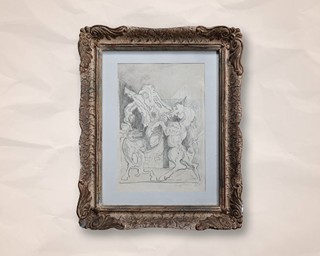
An original pencil study by Emil Filla dating from 1936–1939 and belonging to the important thematic area of Fights and Struggles, which became one of the defining subjects of his pre-war oeuvre. Through human and animal figures, Filla explored physical confrontation, movement, strength and resistance, developing these themes across drawing, printmaking, painting and sculpture. The immediacy of the drawing is particularly compelling. Pencil allowed Filla to explore form, rhythm and the interaction of individual masses without the intervention of a later painterly layer. Line functions not merely as contour but as an active means of constructing movement and tension. Preparatory works of this kind provide a valuable insight into Filla’s creative process and compositional thinking. The motif of struggle acquired a broader symbolic dimension in Filla’s work during the second half of the 1930s. Confrontations between humans and animals or between fighting creatures transcended the individual scene and became more universal images of force, threat and resistance. Emil Filla (1882–1953) was one of the central figures of Czech modern art and a founder of Czech Cubism. As a member of the Osma group, the Group of Fine Artists and the Mánes Association of Fine Artists, he played a fundamental role in the development of the Czech avant-garde. His extensive oeuvre encompasses painting, drawing, printmaking, sculpture and art theory. Of particular interest is the placement of this drawing immediately after lots #108 Theseus Carrying the Cretan Bull (Study) and #109 Fights and Struggles. Together, the three works offer a fascinating encounter with several manifestations of one of Filla’s major pre-war themes, ranging from spontaneous drawing studies to a more fully developed figurative composition. Signed by the artist. Provenance: extensive private Moravian collection. CURATOR’S TIP: An engaging Filla drawing from the important period of 1936–1939. Together with lots #108 and #109, it forms an exceptional thematic group illustrating Filla’s sustained exploration of struggle, movement and physical confrontation. INVESTMENT RECOMMENDATION: Original drawings by Emil Filla provide an accessible collecting opportunity within the oeuvre of one of the most important Czech modernists. The 1936–1939 dating, association with the significant Fights and Struggles theme, artist’s signature and distinguished provenance strengthen the collecting appeal of this work.
Author
Emil Filla se narodil 3. dubna 1882 v Chropyni. V letech 1903 - 1906 studoval monumentální malbu na Akademii výtvarných umění v Praze pod vedením Vlaho Bukovace. Kvůli nespokojenosti s konvenčními metodami a náplní výuky školu opustil po třech letech. Ve svých raných letech byl Filla silně ovlivněn dílem Edvarda Muncha, a následně se přiklonil ke kubismu, který se v jeho díle začal projevovat od roku 1910.
Během své kariéry byl členem několika uměleckých skupin. Nejprve se stal členem skupiny Osma, s níž vystavoval v letech 1907 a 1908. V roce 1909 se přidal ke Spolku výtvarných umělců Mánes, kde setrval – s výjimkou období působení ve Skupině výtvarných umělců mezi lety 1911 – 1914 – až do své smrti.
V roce 1945 byl jmenován profesorem na Vysoké škole uměleckoprůmyslové v Praze. Během svého života se věnoval nejen malbě a grafice, ale také sochařství a teorii výtvarného umění. Byl také spoluredaktorem Volných směrů a formoval směřování českého kulturního dění především v meziválečném období. Jeho raná tvorba byla ovlivněna expresionismem a později Picassovým kubismem. Ve svém závěrečném období se přiklonil k realistické krajinomalbě, zejména krajin Českého středohoří. Tyto krajiny byly inspirovány dílem holandského krajináře Jana van Goyena.
Kromě své umělecké kariéry prodělal Filla během druhé světové války těžké období v koncentračním táboře v Buchenwaldu, kde trpěl zdravotními problémy, které trvale poznamenaly jeho zdraví. Po válce, navzdory komunistickému režimu, který propagoval socialistický realismus, se Filla nadále věnoval svému umění.
Emil Filla zemřel 7. října v Praze.



![[object Object]](https://cdn.livebid.cz/authors/3835.jpg?v=3)
