Basic info
| Rok díla | 1925 |
| Technika | kvaš na papíře |
About
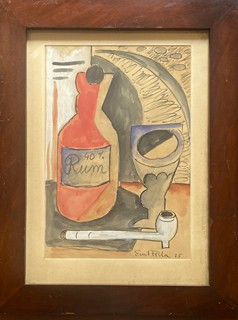
A striking still life by Emil Filla from 1925 combines several motifs characteristic of the artist's interwar work – a bottle, a goblet and a pipe – within a boldly stylised composition. The dominant bottle marked “Rum 40%”, together with the goblet and white pipe, creates an almost theatrical arrangement in which everyday objects acquire a distinct pictorial monumentality. Filla abandons conventional illusionistic space in favour of overlapping forms, geometric simplification and expressive abbreviation while retaining the recognisability of the individual objects. A restrained yet powerful palette of red, ochre, blue, grey and black gives the work considerable visual energy. Emil Filla was one of the most important figures of Czech modern art and a leading representative of Czech Cubism. A member of the Osma group and later the Group of Fine Artists, he played an important role in introducing European avant-garde tendencies into Czech art. Still life was one of his central subjects, allowing him to explore pictorial structure, form and the relationships between individual objects. The present work is dated 1925, placing it within Filla's mature interwar period. Particularly appealing is the combination of modernist construction with an immediately recognisable and intimate subject. The bottle of rum, goblet and pipe evoke the atmosphere of a private gathering while simultaneously providing the artist with material for a distinctly modern transformation of reality. Executed in gouache on paper, the work is signed and dated lower right “Emil Filla 25”. Of particular interest is the handwritten dedication on the reverse: “Milému pánu Hloupému srdečně Emil Filla” (“To dear Mr Hloupý, cordially, Emil Filla”). This personal inscription represents an interesting provenance element and provides a direct connection between the work and the artist. The work is presented in a passe-partout, framed and glazed. CURATOR'S TIP: This is a Filla with a story. The bottle of rum, goblet and pipe almost feel like an invitation to sit down at the table, while the handwritten dedication on the reverse adds an unusually personal dimension. Rather than an anonymous work originally intended for the market, we are looking at a piece that Filla personally dedicated to someone. The combination of a characteristic Filla composition, the 1925 date and this intimate detail makes the work particularly memorable and appealing to a collector. FOR INVESTORS: Emil Filla remains one of the most important and consistently sought-after names in Czech modern art. This work combines several attractive collecting attributes: an interwar date of 1925, a characteristic still-life subject, a clearly visible signature and date, and a personal handwritten dedication on the reverse. With a starting price of CZK 150,000, it offers an attractive entry point for acquiring an original work by one of the key figures of Czech Cubism and represents an interesting opportunity for both established and new collectors.
Author
Emil Filla se narodil 3. dubna 1882 v Chropyni. V letech 1903 - 1906 studoval monumentální malbu na Akademii výtvarných umění v Praze pod vedením Vlaho Bukovace. Kvůli nespokojenosti s konvenčními metodami a náplní výuky školu opustil po třech letech. Ve svých raných letech byl Filla silně ovlivněn dílem Edvarda Muncha, a následně se přiklonil ke kubismu, který se v jeho díle začal projevovat od roku 1910.
Během své kariéry byl členem několika uměleckých skupin. Nejprve se stal členem skupiny Osma, s níž vystavoval v letech 1907 a 1908. V roce 1909 se přidal ke Spolku výtvarných umělců Mánes, kde setrval – s výjimkou období působení ve Skupině výtvarných umělců mezi lety 1911 – 1914 – až do své smrti.
V roce 1945 byl jmenován profesorem na Vysoké škole uměleckoprůmyslové v Praze. Během svého života se věnoval nejen malbě a grafice, ale také sochařství a teorii výtvarného umění. Byl také spoluredaktorem Volných směrů a formoval směřování českého kulturního dění především v meziválečném období. Jeho raná tvorba byla ovlivněna expresionismem a později Picassovým kubismem. Ve svém závěrečném období se přiklonil k realistické krajinomalbě, zejména krajin Českého středohoří. Tyto krajiny byly inspirovány dílem holandského krajináře Jana van Goyena.
Kromě své umělecké kariéry prodělal Filla během druhé světové války těžké období v koncentračním táboře v Buchenwaldu, kde trpěl zdravotními problémy, které trvale poznamenaly jeho zdraví. Po válce, navzdory komunistickému režimu, který propagoval socialistický realismus, se Filla nadále věnoval svému umění.
Emil Filla zemřel 7. října v Praze.



![[object Object]](https://cdn.livebid.cz/authors/3835.jpg?v=3)
