Basic info
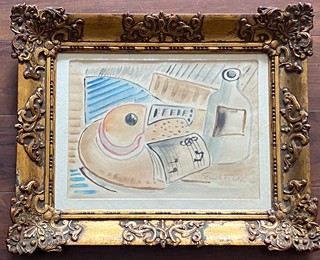
| Rok díla | 1926 |
| Technika | akvarel a tuš na papíře |
About
This intimate work by Emil Filla, dated 1926, is an appealing example of the artist's mastery of watercolour, ink and line. The composition is constructed from several objects dominated by a tall bottle, an open sheet of music and a distinctive organically shaped motif on the left. Rather than depicting these objects descriptively, Filla transforms them into simplified shapes, lines and colour planes, creating an autonomous pictorial whole. The delicate watercolour palette is based on subdued ochres, greys and blues complemented by subtle pink accents. Transparent areas of colour are contrasted with confident dark ink drawing that determines the rhythm of the entire composition. This contrast between the lightness of the watercolour and the firmness of the drawing gives the work remarkable immediacy. The motif of open sheet music refers to music, a theme that repeatedly appears alongside other objects associated with cultural and sensory experience in Filla's still lifes. The year 1926 belongs to an important period of Filla's oeuvre, when his Cubist foundations developed towards a freer and more lyrical expression. Despite its relatively intimate dimensions, the composition possesses a strong visual presence due to the carefully balanced arrangement of forms across the entire sheet. The work is signed and dated lower right “Emil Filla 26”. It is preserved in excellent condition and presented in its original decorative frame, mounted and glazed. The work comes from an extensive private Moravian collection. The authenticity of the work was professionally consulted with PhDr. Michael Zachař, a respected Czech art historian and specialist in Czech art of the 19th and 20th centuries, who confirmed the authenticity of the work. This expert confirmation represents significant added value in terms of both collector confidence and the investment potential of the work. Curator's recommendation: A highly appealing and visually refined work on paper from Emil Filla's important interwar period. The combination of watercolour and ink reveals the artist's exceptional confidence as a draughtsman, while the sheet-music motif adds a lyrical and cultural dimension to the composition. The clearly visible signature and date 1926 are particularly attractive features. The confirmation of authenticity by PhDr. Michael Zachař further strengthens the collector significance of this lot. Recommendation for collectors and investors: Emil Filla ranks among the most important and consistently sought-after artists of Czech modernism. Particularly noteworthy here are the characteristic still-life subject, the desirable interwar date of 1926, the clearly dated signature and the combination of watercolour and ink. Another significant factor is the expert consultation with PhDr. Michael Zachař, who confirmed the authenticity of the work. The starting price of CZK 100,000 is deliberately attractive and leaves substantial room for competitive bidding.
Author
Emil Filla se narodil 3. dubna 1882 v Chropyni. V letech 1903 - 1906 studoval monumentální malbu na Akademii výtvarných umění v Praze pod vedením Vlaho Bukovace. Kvůli nespokojenosti s konvenčními metodami a náplní výuky školu opustil po třech letech. Ve svých raných letech byl Filla silně ovlivněn dílem Edvarda Muncha, a následně se přiklonil ke kubismu, který se v jeho díle začal projevovat od roku 1910.
Během své kariéry byl členem několika uměleckých skupin. Nejprve se stal členem skupiny Osma, s níž vystavoval v letech 1907 a 1908. V roce 1909 se přidal ke Spolku výtvarných umělců Mánes, kde setrval – s výjimkou období působení ve Skupině výtvarných umělců mezi lety 1911 – 1914 – až do své smrti.
V roce 1945 byl jmenován profesorem na Vysoké škole uměleckoprůmyslové v Praze. Během svého života se věnoval nejen malbě a grafice, ale také sochařství a teorii výtvarného umění. Byl také spoluredaktorem Volných směrů a formoval směřování českého kulturního dění především v meziválečném období. Jeho raná tvorba byla ovlivněna expresionismem a později Picassovým kubismem. Ve svém závěrečném období se přiklonil k realistické krajinomalbě, zejména krajin Českého středohoří. Tyto krajiny byly inspirovány dílem holandského krajináře Jana van Goyena.
Kromě své umělecké kariéry prodělal Filla během druhé světové války těžké období v koncentračním táboře v Buchenwaldu, kde trpěl zdravotními problémy, které trvale poznamenaly jeho zdraví. Po válce, navzdory komunistickému režimu, který propagoval socialistický realismus, se Filla nadále věnoval svému umění.
Emil Filla zemřel 7. října v Praze.



![[object Object]](https://cdn.livebid.cz/authors/3835.jpg?v=3)
