Basic info
| Rok díla | 1946 |
| Technika | olej na desce |
About
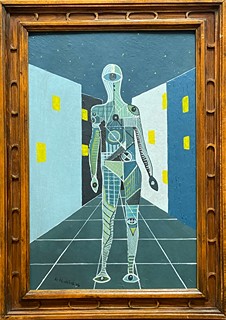
František Hudeček (1909–1990) ranks among the most important representatives of Czech modern art of the 20th century. He was a painter, graphic artist and illustrator and, above all, one of the founding members of Group 42. His work is characterised by a fascination with the modern city, nocturnal landscapes, the solitary human figure and the relationship between man and the environment of modern civilisation. The Night Walker became one of the defining motifs of his oeuvre, recurring in various forms in his drawings, prints and paintings. Hudeček combined surrealist imagination, geometric stylisation of the figure and the civilist poetics of Group 42 into a highly distinctive artistic language. The striking figurative work Robot dates from 1946, one of the most important periods of the artist’s career. The monumental figure stands within a geometrically constructed nocturnal urban space punctuated by glowing yellow windows and a deep blue sky. The human figure is transformed into a complex organism composed of lines, geometric fields, circles, grids and structures reminiscent of technical mechanisms. The recurring eye motif on the head, shoulder, hands and legs gives the composition a strong symbolic and surreal dimension. Hudeček combines man, technology, the city and the cosmos into a single pictorial organism. The work convincingly develops his fundamental theme of the solitary figure within the modern urban environment, explored during the 1940s in connection with Group 42. The figure appears simultaneously human, mechanical and fantastical, embodying the characteristic tension between the alienation of modern man and his connection with the surrounding world. Precise geometric drawing contrasts with subdued blue-green tones and sharp accents of illuminated windows. The painting is signed and dated lower left “Fr. Hudeček 46”. An older inscription on the reverse refers to the artist, the title Robot and the oil technique. The work is presented in its original wooden frame and comes from a private Prague collection. CURATOR’S TIP: An exceptionally attractive work by Hudeček from the key year 1946, concentrating the characteristic themes of his 1940s oeuvre – man, the city, technological civilisation, geometry and the mystery of nocturnal space. Its substantial format, oil technique, original frame and exceptionally distinctive figurative motif make Robot one of the notable lots of the auction. FOR INVESTORS: František Hudeček is one of the key representatives of Group 42, and his works from the 1940s constitute a particularly significant and collectible part of his oeuvre. This work combines the important date of 1946, oil technique, a substantial format, signature and dating, and a highly representative subject.
Author
František Hudeček se narodil 7. dubna 1909 v Němčicích u Holešova a ze světa odešel 13. května 1990 v Praze. Jako význačná postava českého umění 20. století se etabloval nejen jako malíř, ale také jako fotograf, ilustrátor, grafik a typograf. Svá studia zahájil na Uměleckoprůmyslové škole v Praze, kde byl žákem Františka Kysely. Brzy se stal členem prestižní Umělecké besedy a následně i avantgardní Skupiny 42. V šedesátých letech byl součástí tvůrčí skupiny Radar.
Ve třicátých letech 20. století experimentoval Hudeček s různými technikami. Jedna z nich, frotáž, unikátní technika vytváření obrazů z náhodně ztuhlých škrobových papírů, kterou nazval "škrobáci", mu přinesla široké uznání. Díky škrobákům vzniklo jeho pravděpodobně nejznámější dílo, objekt "Sokrates a Faidros čili o kráse", které je nyní součástí sbírky GASK – Galerie Středočeského kraje.
Avšak koncem třicátých let podstoupil Hudeček změnu v uměleckém vyjádření. Místo abstraktního fantaskna se zaměřil na konkrétní realitu městské krajiny a osamělých postav v ní. Zde stvořil svůj osobní obraz "nočního chodce", což byla postava, která v mnoha ohledech reprezentovala Hudečka samotného. S narůstající tendencí ke geometrizaci svých obrazů zobrazoval řád vesmíru a urbanismus.
Po období pomlky během padesátých let se Hudeček vrátil k malování s obnoveným zápalem. Jeho pozdější díla vykazovala silný dvojznačný charakter: na jedné straně hmotné skrumáže přírodních motivů a na druhé straně abstraktní, geometrické formy inspirované vlastnostmi světla, připomínající tehdy populární op-art.
František Hudeček byl aktivní i v oblasti výstav. Jeho poslední samostatná výstava se konala v roce 2006 v Galerii U Betlémské kaple v Praze, což potvrdilo jeho trvalý význam v českém uměleckém prostředí.



![[object Object]](https://cdn.livebid.cz/authors/6304.jpg?v=2)
