



![[object Object]](https://cdn.livebid.cz/authors/3833.jpg?v=1)
Basic info
| signatura | sign. FILKO 1982 |
| technika | kombinovaná technika, papír |
| rozměry | 200 × 140 cm |
| rám | rám |
| rok | 1982 |
About
EXHIBITED
Filko, Knížák, Nitsch a Ruller, Etcetera Art, Praha, 2023
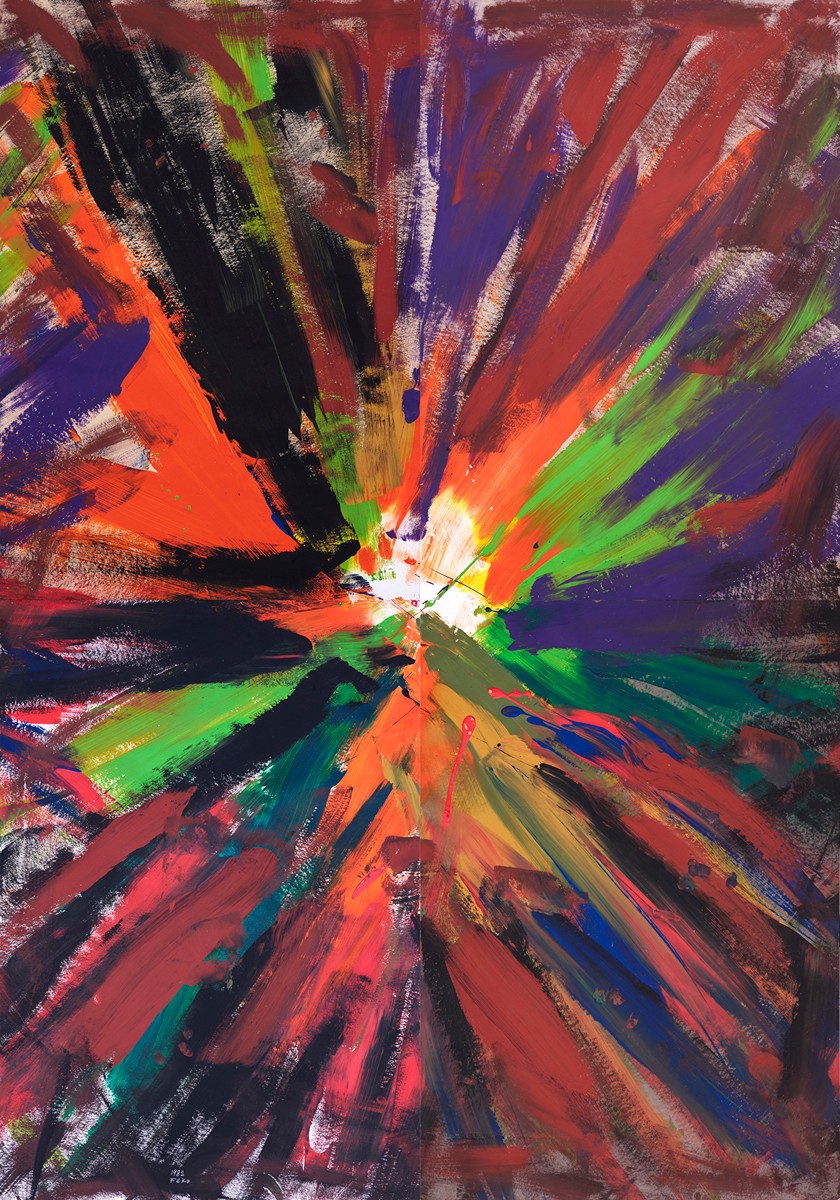
The work belongs to the period of the artist's work when he devoted himself to neo-expressionist painting, which was highly topical within the strong postmodern current (the author was living in emigration at the time and was influenced by the artistic developments in Western Europe and the USA). In addition, the work is also a continuation of Stan Filk's earlier stages of avant-garde artistic explorations, in which he focused on futuristic (though partly ironic) visions of humanity's expansion into cosmic dimensions. The painting can be understood as a projection of the "big bang", the birth of a new cosmic order, out of which will emerge the future harmonious harmony between man and the universe. Since the 1960s, Stano Filko has created a considerable number of installations, objects, collages, performances, events, etc. on this theme.
Stano Filko represented a pioneering, unprecedented artistic individuality in the Czechoslovak environment. He combined avant-garde experimentation, which was inspired primarily by the example of Marcel Duchamp, with the social dimension and impact of artistic endeavour, in which he approached the thinking of Joseph Beuys, for example. His main goal was to compose a holistic, sensual artistic environment, and he saw individual artefacts as partial stops on the way to this complex task. In the spirit of avant-garde thinking, he wanted to transform not only the artistic sphere, but also the social and ideological qualities of the world. He created a series of utopian projects and proposals, which he simultaneously reflected and lightened in an ironic way. In his work he sometimes referred directly to exemplary personalities, works and events from the avant-garde. Thus, he transformed Malevich's White Square on a White Background (which followed the better-known Black Square) into White Space in White Space (1974), adding not only a third dimension to the iconic avant-garde work, but also somewhat easing the legend that inevitably builds up around groundbreaking works.
Filkov's 1982 painting comes from the opposite spectrum of the artist's interests. Instead of a completely emptied spiritual space, we see here an intense colour and gestural agency. Here the artist reflected not only the change of the times and the otherness of the environment in which he found himself, but also traced a certain arc from emptiness to fullness, and in this way he was actually simultaneously working on his project of a complex work uniting opposites and diversities in a harmonizing holistic spirit.
Author
Stanislav Filko se narodil 15. června 1937 ve Veľké Hradné a byl slovenským konceptuálním umělcem. Patřil k významným představitelům slovenského poválečného umění a byl průkopníkem neoavantgardy od 60. let společně s umělci jako Julius Koller a Alex Mlynárčik.
Filko vystavoval svá díla nejen v Československu, ale také v Itálii, Francii, Německu a Spojených státech amerických. Později emigroval do Německa, odkud odjel do New Yorku. Po revoluci v roce 1989 se však rozhodl vrátit zpět na Slovensko.
V roce 2005 se Stanislav Filko spojil s umělci Jánem Mančuškou a Borisem Ondreičkou a kurátorem Markem Pokorným k vytvoření expozice Československého pavilonu na Benátském bienále. Zemřel 23. října 2015.
