

![[object Object]](https://cdn.livebid.cz/authors/12107.jpg?v=3)
Basic info
| Technika | černobílá fotografie, vintage print |
| Rozměr | 23,5 × 17 cm |
| __EMPTY | 80. LÉTA |
About
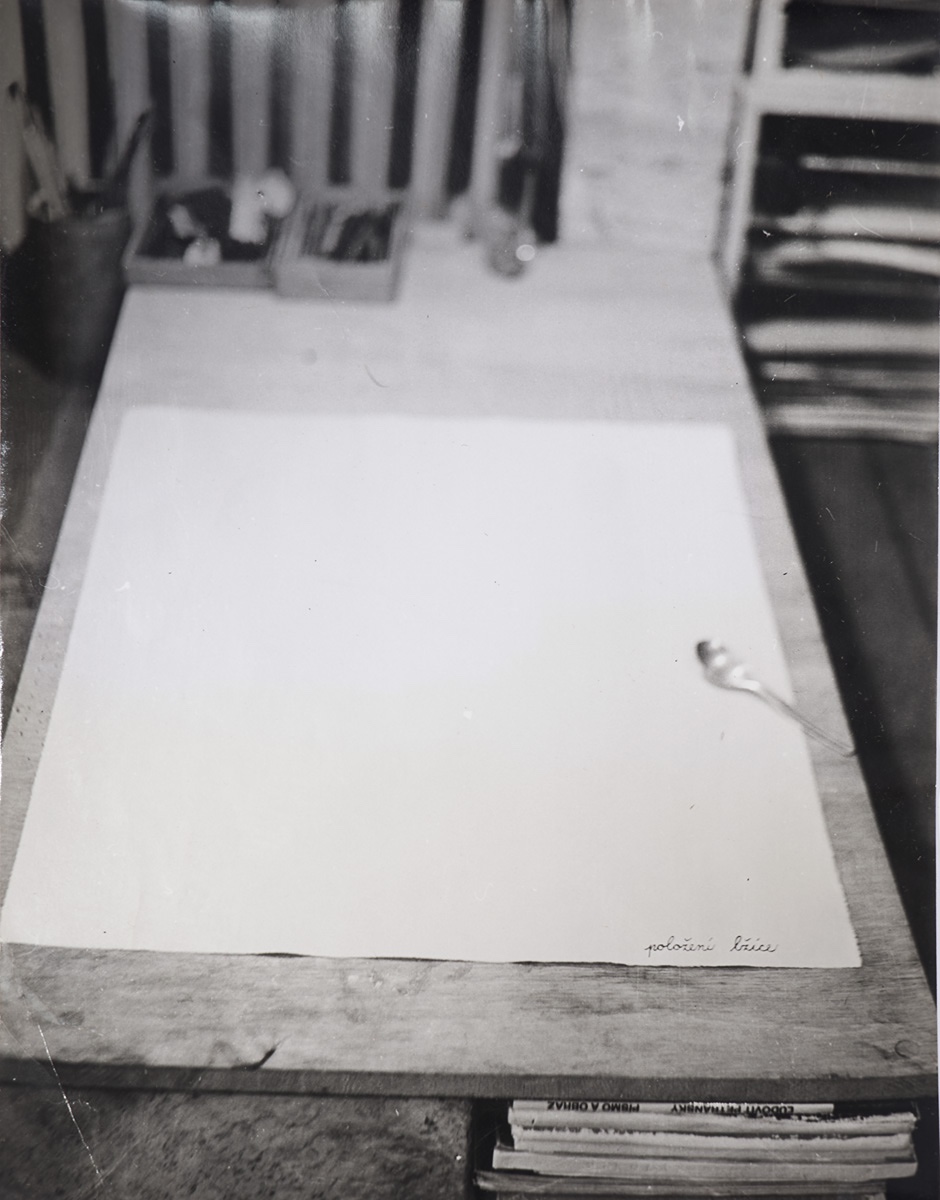
black and white photography, vintage print
signed on the reverse by M. Palla
Marian Palla, although born in Košice in 1953, has lived and worked in Brno and its surroundings his entire life, currently in Střelice. Palla is closely connected with Brno's alternative, formerly unofficial, art scene. In the mid-1970s, he graduated from the conservatory, majoring in double bass, and spent fifteen years playing in the Brno State Opera orchestra. In the 1970s, gifted with the opportunity to use his father's studio in the attic on Kotlářská Street, he began to devote himself as a self-taught artist to visual art, happenings, and performance art. It was in the 1970s that Palla became aware of his own expressive potential under the influence of his close friendships with people around Jiří Valoch, who soon began to gather in Palla's studio, where they held lectures, musical performances, recitals, and presentations of works. Palla experimented intensively and explored the possibilities of stylizing pictorial expression, but always in connection with text. He often went to the very limits of simplification, using unconventional techniques and natural materials. Initially, he did not sign or date his works, so it is difficult to determine the chronology of his work, which makes the important refrains that still resonate in his work today all the more significant. These mainly concern nature and everyday situations as events exposed in the image. By the end of the 1970s, Palla had dozens of smaller-format paintings to his credit, whose message gradually became semantically more complex, with the relationship between text and image no longer straightforward. Sometime around this time, Palla began experimenting with texts and creating author's books or descriptions of situations. Among his most radical expressions are entire sheets of paper covered with illegible pseudo-writing that consistently avoids any resemblance to any known linguistic symbols. Among his best-known works from the 1970s is a series of portraits of friends characterized by simplified linear representations of the human figure, distinguished in the case of women only by a hint of breasts, otherwise almost identical. Each figure or group of figures is labeled with its name in capital letters.
Pallo's artistic portfolio began to expand at the turn of the 1970s and 1980s, when he and his wife moved to Rousínov. Nature and its observation or intervention began to take on a special position. He began to work more with photography, objects, poetry, music, but also land art and body art. He still skates between these disciplines, crossing them and sometimes deliberately disregarding their boundaries. His work continues to feature a subversive and humorous element that unsettles the viewer but also entertains them. He consistently avoids any strict classification, and if anything, he describes himself as a naive conceptualist, explaining in an interview for Art+Antiques in 2016: "Conceptualism as such was hard and dry for me." Among his best-known actions from the early 1980s are Painting Lines, which resulted in four canvases that differ only in the duration of the painting (the longest is 24 hours), or In This Painting I Existed for Two Days and Ate 7,799 Grains of Rice (1981), for which he informed his friends in advance and instructed them on how to behave if they visited him during those two days. In both cases, the resulting paintings are a record of these events.
Between 1988 and 1990, Palla, together with Dalibor Chatrný, Petr Kvíčala, Jiří Valoch, Miloš Šejn, and Jiří Šigut, initiated the founding of the art group Měkkohlaví (Softheads). His work continued to move in the areas described above, and during the 1990s, when he was already teaching at the Faculty of Fine Arts at the Brno University of Technology (Environment Studio), he returned to the pictorial form he had used before his departure to Rousínov.
In addition to his visual works, Marian Palla has also published several books, including Naivní konceptualista a slepice (The Naive Conceptualist and the Hen, 2014), Njkpůúp kkléedc (2011), Teplé škvarky (Warm Cracklings, 2007), and Jak zalichotit tlusté ženě (How to Flatter a Fat Woman, 1996). The second of these books in particular—which is unreadable—can be considered the pinnacle of Palla's literary experiments, which are otherwise relatively moderate, i.e., readable. In addition to these activities, Palla, as already mentioned, worked as an assistant professor at the Environment Studio at the Faculty of Fine Arts of the Brno University of Technology from 1994 to 2011. He himself graduated from the Multimedia, Concept and Environment Studio in 2000. Marian Palla is also the first Czech Republic champion in slam poetry (2003). In recent years, interest in Palla's work has grown thanks to the awarding of the Michal Ranný Prize in 2016. His work has been exhibited at the Brno House of Arts (2016) and the Moravian Gallery (2017).
• Martin Vaněk
Author
Marian Palla, narozený 30. července 1953 v Košicích, je český prozaik, básník, výtvarník, vysokoškolský pedagog, publicista a recesista.
Po ukončení studia na konzervatoři v Brně v oboru kontrabas v roce 1977 hrál přes patnáct let v orchestru Janáčkovy opery v Brně. Vedle hudební činnosti se věnuje také výtvarnému umění a má za sebou několik samostatných výstav, jak v České republice, tak v zahraničí. Jeho díla jsou součástí sbírek Národní galerie v Praze, Východočeské galerie v Pardubicích, Muzea umění v Olomouci a Moravské galerie v Brně. V období od roku 1994 do 2011 působil pedagogicky na Fakultě výtvarných umění VUT v Brně, kde zastával post asistenta a později docenta. V roce 2000 absolvoval Atelier multimedia, koncept, environment na FaVU VUT. Palla je také členem několika uměleckých skupin, například Florián.
Marian Palla je autorem několika knih, včetně sci-fi knihy pro děti s názvem "Ve znamení hada," kterou napsal společně s Janem Jiráněm. Kromě toho se stal historicky prvním mistrem České republiky ve slam poetry v roce 2003. V roce 2016 obdržel Cenu Michala Ranného. V současné době je v důchodu a žije a tvoří ve Střelicích u Brna.
