Basic info
| datace | 2025 |
| rozměr | 43,5 x 61 x 29 cm |
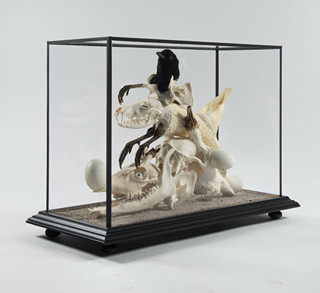
| technika | zvířecí ostatky, přírodniny, plexisklo, dřevo, písek |
| signatura | sign. a dat. zespodu: Třípatrové zvíře, 2025 / Švankmajer J. |
About
The exhibit of an imaginative creature with the ability to address the viewer and draw him into an inspiring dialogue is a representative example of one of the objects from Jan Švankmajer's so-called handheld Kunstkamera. The artist's work is largely determined by the philosophy and creative practices of surrealism. His cinematic work is inextricably linked to his other artistic expressions, be it drawings, collages, frottage, objects or his unique experimentation with the perception of artworks through touch (tactile art). In this sense, his work is thus an embodiment of the synergistic effect or - to use Surrealist terminology - the universality of artistic expression. Other characteristic features of the artist include "co-creation with nature", the theme of terror and pleasure, funeral representation or magic. A leading representative of the Czech film and art scene of the last forty years, he entered the field of film in the 1960s, during the Czech New Wave, and made his first film, The Last Trick of Mr Schwarcewallde and Mr Edgar, in 1964. After that, he focused on short films, combining elements from puppetry, animation and feature film elements. He gained international attention in 1983 with a showcase of his films from the 1960s at the FIFA International Film Festival. In 1988 he made his first feature film, Something of Alice, which was a worldwide success. In the year of his 90th birthday, the exhibition DISEGNO INTERNO was held at the Central Bohemian Region Gallery GASK, which presented a cross-section of the life work of Jan Švankmajer and his wife Eva Švankmajerová (1940-2005) in an original concept. The work on offer comes from the artist's studio.
Author
Jan Švankmajer se narodil 4. září 1934 v Praze. Už od dětství měl vztah k výtvarnému umění a loutkám, které byly jeho nejoblíbenější zábavou. Studoval na Vyšší škole uměleckého průmyslu v Praze a na loutkářské katedře DAMU. Svou kariéru zahájil jako loutkoherec v krátkometrážním filmu Johanness Doktor Faust.
V roce 1960 se oženil s Evou, která se později podílela na jeho filmech nejen jako manželka, ale i jako výtvarnice. Společně založili Divadlo masek a Švankmajer se také věnoval režii v Laterně magice. Později se věnoval filmové tvorbě a stal se členem surrealistické skupiny v Československu.
Jeho práce byla ovlivněna surrealismem a experimentální animací. Mezi jeho nejznámější filmy patří Něco z Alenky, který mu přinesl celosvětovou proslulost. Postupně se stal jedním z nejuznávanějších českých filmařů mimo hranice, přičemž jeho práce inspirují studenty animace po celém světě.
Švankmajer se neuchýlil k mainstreamu a jeho filmy nezaznamenaly komerční úspěch, nicméně každá jeho práce byla filmovou událostí. Vedle filmové tvorby se Švankmajer podílel na tvorbě surrealistického časopisu Analogon a jeho výtvarný rukopis je velmi specifický. Mimo to spolupracoval například s Peterem Gabrielem na tvorbě videoklipu k písni Sledgehammer.
Jan Švankmajer je považován za vizionáře, který významně obohatil obor animace a jeho práce jsou dodnes velmi respektovány a oceňovány po celém světě.




![[object Object]](https://cdn.livebid.cz/authors/16383.jpg?v=3)
