Basic info
| rok díla | 1980 |
| technika | bromostříbrná fotografie |
About
1980
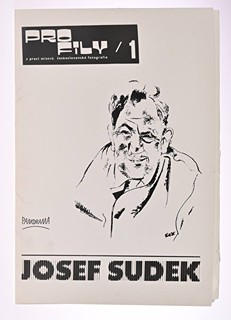
Format 4°, 29.5x20.5 cm. A complete set of 18 reproductions of photographs by J. Sudek, loose sheets in the original wrapper, and a 27-page booklet of accompanying text by Petr Tausk in Czech, Russian, German, English and French. Published by the Panorama publishing house in Prague in 1980.
Slightly creased margins and a bumped and torn lower right corner of the wrapper, several minimally frayed/bumped corners (mostly lower right); the accompanying text has a bent lower right corner and traces of rust at the seams and on the inside of the wrapper.
Josef Sudek was born in Kolín nad Labem, attended a trade school in Kutná Hora, then trained as a bookbinder in Prague and began photographing. While fighting in the First World War, where he also took photographs, he lost his right arm to a grenade blast. After the war he refused a state tobacconist's licence offered to war veterans, reportedly because "it was spring and the sparrows were chirping". From 1920 a member of the Czech Club of Amateur Photographers, and a founding member of the Photo Club (1922-1924). Between 1922 and 1924 he studied at the State School of Graphic Arts under Prof. K. Novák. After leaving the Czech Club of Amateur Photographers he founded, together with J. Funke and A. Schneeberger, the Czech Photographic Society in 1924 (approx. 1924-1930). In 1927, together with A. Schneeberger, he acquired a photographic studio, which he used together with his sister until his death. Between 1927 and 1936 he worked for the Družstevní práce publishing house, where he photographed in the spirit of functionalism for L. Sutnar. He also collaborated, for example, with the magazine Pestrý týden. From 1927 he used a garden studio in Újezd, set up his own firm and became a sought-after specialist, creating in the spirit of New Objectivity. In his work he drew inspiration from D. J. Růžička, A. Stieglitz, C. H. White and American purist pictorialism. His subjects were chiefly reproductions of works of art, portraiture, genre scenes, Prague architecture, mood landscapes and still lifes. After Sudek's death, his sister Božena Sudková donated his photographic work to the Museum of Decorative Arts in Prague, and his art collection to the National Gallery; part of his legacy was also acquired, for example, by the Moravian Gallery and the Institute of Art History of the Academy of Sciences.
Author
Josef Sudek se narodil 17. března 1896 v Kolíně. Byl významným českým fotografem, který se proslavil svými snímky pražských motivů, ateliérových aranžmá, zátiší, reportáží, krajiny a reklamní fotografie. S fotografováním začal již ve svých 17 letech.
Sudekovy rané fotografie ve 30. letech reflektovaly vnější svět a moderní trendy, ale až od 40. let se začal ubírat vlastní cestou a vyvinul nezaměnitelný tvůrčí styl, který ho proslavil i v zahraničí. Začal fotografovat proslulé pohledy z okna svého ateliéru a komponovaná zátiší, často vytvářená technikou kontaktního otisku různě velkých negativů na pozitivní papír.
Sudekova kariéra nebyla přerušena ani válkou, ani politickým tlakem v poválečném období, kdy byl nucen dodržovat doktrínu socialistického realismu. Naopak se v té době vrátil k piktorialismu a vytvořil řadu prací, které předjímaly pozdější vývoj fotografie směrem k postmoderní syntéze.
Josef Sudek je spolu s dalšími českými fotografy, jako jsou František Drtikol, Jaroslav Rössler a Jaromír Funke, považován za jednoho z nejvýznamnějších českých fotografů období mezi dvěma světovými válkami. Je také uznáván jako avantgardní fotograf v Evropě.
Josef Sudek zemřel 15. září 1976 v Praze, ale jeho dílo nadále žije a slouží jako inspirace pro další generace fotografů.



![[object Object]](https://cdn.livebid.cz/authors/15689.jpg?v=3)
