Basic info
| rok díla | 1921 |
| technika | bromostříbrná fotografie |
About
1921
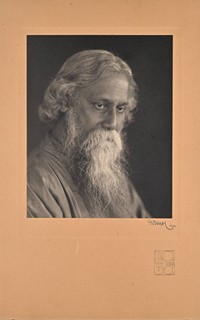
Gelatin silver print on matte paper, original vintage enlargement by the artist. 27.9x22.3 cm. Recto blind-stamped lower left "DRTIKOL & SPOL. PRAHA 1921". Mounted on card. Marked on the mount with the artist's stamp "DRTIKOL & SPOL. UMĚLECKÁ FOTOGRAFIE PRAHA 730"; lower right beneath the image on the mount signed and dated in pencil "Drtikol 1921".
A portrait of the Nobel Prize laureate for literature (1913), made during his first brief visit to Prague in May 1921.
The mounting card slightly damaged; on the photograph only two very small areas of lifted emulsion (approx. 1 mm) upper left.
František Drtikol - Czech photographer and painter, born in Příbram. Between 1898 and 1901 he trained in the studio of Antonín Mattas. From 1901 to 1903 he studied in Munich at the Teaching and Research Institute for Photography. In Munich he acquired both the technology of noble printing processes and creative work in the spirit of Secession pictorialism and symbolism. Between 1903 and 1904 he worked successively in studios in Karlsruhe, Chur, Trutnov and Prague. He then began his three-year compulsory military service. In 1907 he opened his own studio in Příbram, which he closed for financial reasons in 1909 and moved to Prague, where in 1910, with the support of the amateur photographer A. Škarda, he opened his own studio, Drtikol & spol. In 1911 he published a set of 50 oil prints entitled From the Courtyards and Little Courtyards of Old Prague. This set aroused unprecedented acclaim, and Drtikol's studio became one of the leading photographic studios in the Czech lands. In 1914 Drtikol was called up to the reserve army unit in Benešov near Prague, where he remained as a sergeant until the end of the war. His studio continued to operate during this time (in 1917 J. Rössler joined it as an apprentice, working there with interruptions until 1925). After the war he continued to run his studio (after 1921 without A. Škarda) until 1935, when he sold it. In 1939 he donated his archive (around 2,000 photographs, documents and letters) to the Museum of Decorative Arts in Prague. In Drtikol's earliest nudes, elements of Romanticism and Symbolism are combined. His images were always intricately composed, and among the nudes symbolic depictions of biblical and mythological "femmes fatales" appear. Under the influence of modern pictorialism, which was launched in Czechoslovakia by D. J. Růžička's exhibition in 1921, he began to use soft-focus lenses and abandoned most noble printing processes except carbon printing. Before the mid-1920s, elements of Cubism, Futurism and Expressionism worked their way into his images (undoubtedly also thanks to the influence of his assistant J. Rössler). Another significant motif of his work, which gained in urgency during this period, is the dramatic and transcendental treatment of cast shadows and circles or cones of light, which stemmed from his fascination with Buddhism. In 1925 he took part in the Paris International Exhibition of Modern Decorative and Industrial Arts, from which he came away with a Grand Prix, launching a series of exhibitions abroad. Personal disappointment with women led him, towards the end of the 1920s, to replace live models with figurines carved from wood and cardboard, which he photographed in his final creative period (1930-1935).
Author
František Drtikol se narodil 3. března 1883 v Příbrami. Vystudoval gymnázium a později pokračoval ve studiu na Učitelském ústavu v Praze. Později se věnoval fotografii a grafice.
František Drtikol se proslavil jako český fotograf, který aktivně tvořil v letech 1901 až 1935. Jeho práce byly zejména v oblasti portrétní fotografie a aktů. Jeho styl byl ovlivněn pozdní secesí a později také kubisticko-futuristickými prvky. Je považován za jednoho z nejúspěšnějších českých klasiků fotografie aktu.
Kromě fotografie se František Drtikol příležitostně věnoval také grafice a překladatelství. Měl významný vliv na vývoj českého umění fotografie a jeho díla jsou dodnes uznávána a studována.
Mimo svou uměleckou činnost se František Drtikol také zajímal o duchovní praxi východních učení, jako je Bhagavadgita a buddhismus. Je dokonce označován za zakladatele českého buddhismu.
František Drtikol zemřel 13. ledna 1961 v Praze.



![[object Object]](https://cdn.livebid.cz/authors/3165.jpg?v=4)
