
![[object Object]](https://cdn.livebid.cz/authors/18092.jpg?v=2)
About
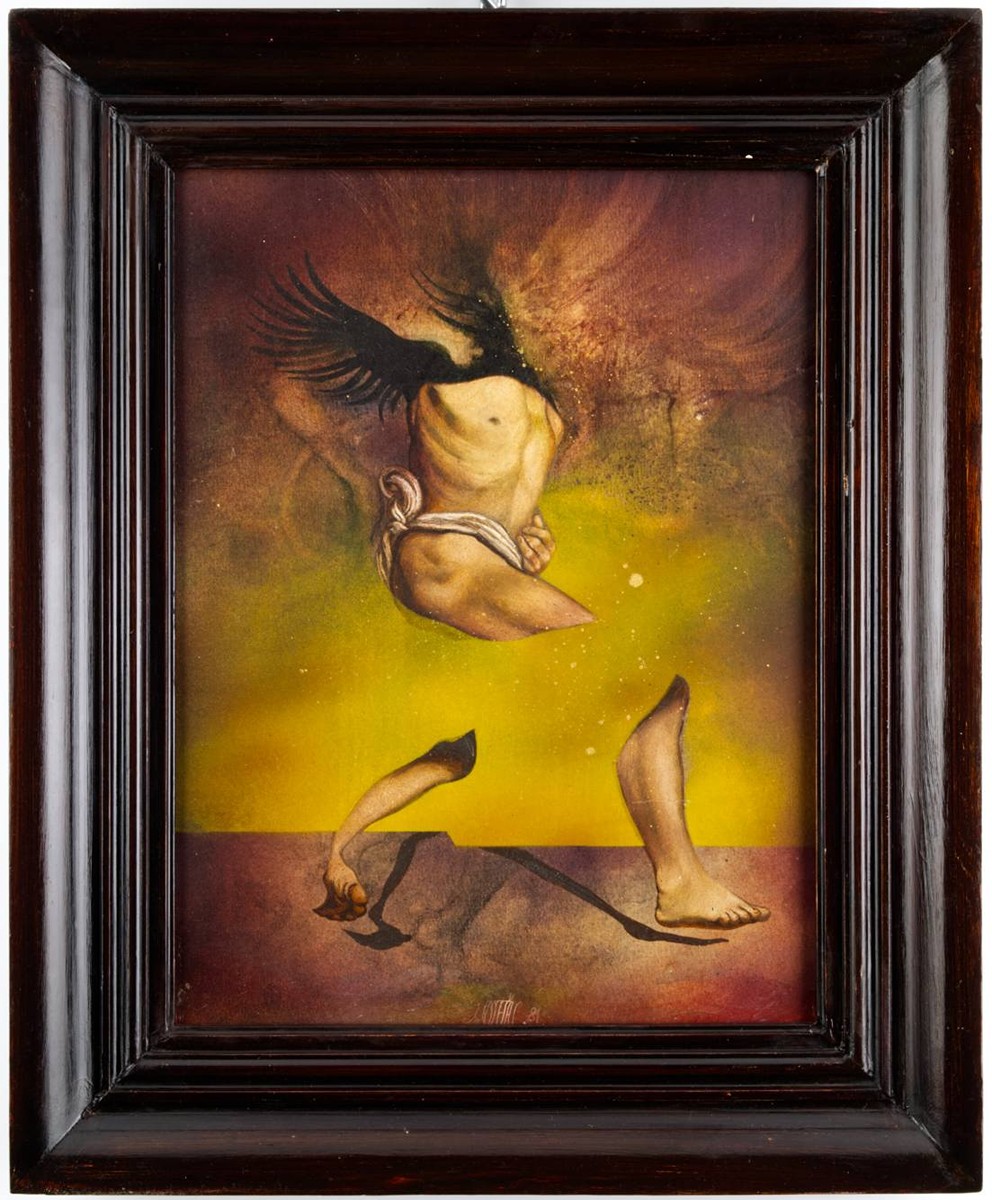
Oil and ink on plywood, 36,5x27 cm (48x39 cm), signed and dated lower center "J. Vyleťal 81". Framed.
In the second painting, the process of transformation shifts into the realm of the dissolution of the physical self. The body is fragmented – legs, torso and wings exist separately, floating in space without a solid physical bond. This corresponds to the mystical and alchemical stage of sublimatio, the spiritual “dematerialisation” in which matter is transformed into a finer substance. The attachment of wings to the body’s torso is a clear symbol of transcendence – yet not a triumphant one, rather an ambivalent one, as is typical for Vyleťal. The wings do not appear angelic, but rather chimeric, somewhere between bird-like and demonic – the transformation is not unequivocal, neither morally nor aesthetically.
Whereas the first painting depicts the threshold, this one represents the passage: the subject recognises that in order to enter a new existence, they must relinquish the old identity and its physical shell. The shadow, which dominated the first painting, is here paradoxically weakened – the transformed body no longer casts it fully. This corresponds to the Jungian symbolism of completed individuation: the integration of the Shadow leads to its dissolution.
The painting Transfiguration has a strong conceptual link to Vyleťal’s motif of the Marathon Runner (in various versions from the 1970s). Although not formally identical, both subjects explore the same idea of the body in a state of extreme transformation and the crossing of human limits. In the context of Vyleťal’s work, the Marathon Runner is understood as a metaphor for a person surpassing the boundaries of their physical being, to the point where the body ceases to be an instrument and becomes an obstacle. Vyleťal often transforms this “run beyond the limits of one’s strength” into a poetic-surreal image of transgression – a person, through their own effort, becoming a different being.
Transfiguration from 1981 takes this idea even further: here the body is no longer merely transcended, but dismantled in the process of transformation. Where the Marathon Runner still symbolically struggles with the limits of his organism, here the physical unity has already given way, and the subject undergoes metamorphosis into another form.
Together, the two paintings represent the culmination of a creative process in which Josef Vyleťal brought his lifelong theme of human transformation to its highest symbolic density. They form a compact diptych that completes Vyleťal’s reflection on the transformation of the human being from a physical entity into a spiritual principle, rendered with exceptional pictorial power and inner logic.
Condition A.
Author
Josef Vyleťa se narodil 18. června 1940 v Brně a zemřel 3. února 1989 v Praze. Byl významný český divadelní výtvarník, grafik, malíř a filmový výtvarník. Svou uměleckou dráhu započal studiem v 50. letech v Bratislavě, a následně v 60. letech pokračoval na UMPRUM v Praze.
Vyleťa studoval na Vysoké škole uměleckoprůmyslové v Praze v ateliéru Adolfa Hoffmeistera, ale byl z něj vyloučen. Následně se začal věnovat scénografii v divadle Na zábradlí a postupem času se začal živit užitou grafikou i volnou tvorbou. Získal si renomé také jako filmový výtvarník, spolupracoval s režiséry Františkem Vláčilem a Janem Němcem. Jeho význačným dílem je freska na stropu kolonády v Mariánských Lázních ze 70. let.
Josef Vyleťa byl známý svými filmovými plakáty. Vytvořil 124 plakátů k různým filmům, a získal ocenění za plakát k filmu "Panna a netvor" na Mezinárodním filmovém festivalu v Chicagu v roce 1979. Mezi jeho nejznámější plakáty patří ty k filmům "Ptáci" Alfreda Hitchcocka, "Bonnie a Clyde" Arthura Penna, "Bezstarostná jízda" Hoppera a "Amarkord" Felliniho.
Josef Vyleťa byl členem významné čtveřice výtvarníků, kteří ovlivnili oblast filmových plakátů v Československu. Společně s ním tvořili tuto čtveřici Zdeněk Ziegler, Karel Vaca a Milan Grygar. Jeho dílo je důležitým prvkem českého uměleckého dědictví a jeho vliv na filmovou kulturu je stále patrný.
