

![[object Object]](https://cdn.livebid.cz/authors/20090.jpg?v=3)
Basic info
| technika | keramika, glazura |
| rok díla | 2024 |
| rámováno | ne |
About
Author
- In 2021 she co-founded the Hlinotéka project in Prague 7, which brings together artists who work and experiment with the material.
- Her exhibitions include Hranice nejednoznačnosti at Galerie MeetFactory and My Name is Dragon at Galerie NIKA.
Johana Hnízdilová is a Czech ceramicist, product designer and graphic designer. She is currently a student at the Academy of Arts, Architecture and Design in Prague, where she studies in the Ceramics and Porcelain Studio. Behind her she also has studies in the Graphic Design II studio at the Faculty of Art and Design in Ústí nad Labem. Her current work reaches beyond applied ceramics towards other disciplines such as graffiti, sculpture, installation, performance, illustration and graphic design. She puts her knowledge of graphic design to use in her emphasis on ornament and in her handling of line and of the colour schemes that are so characteristic of her work.
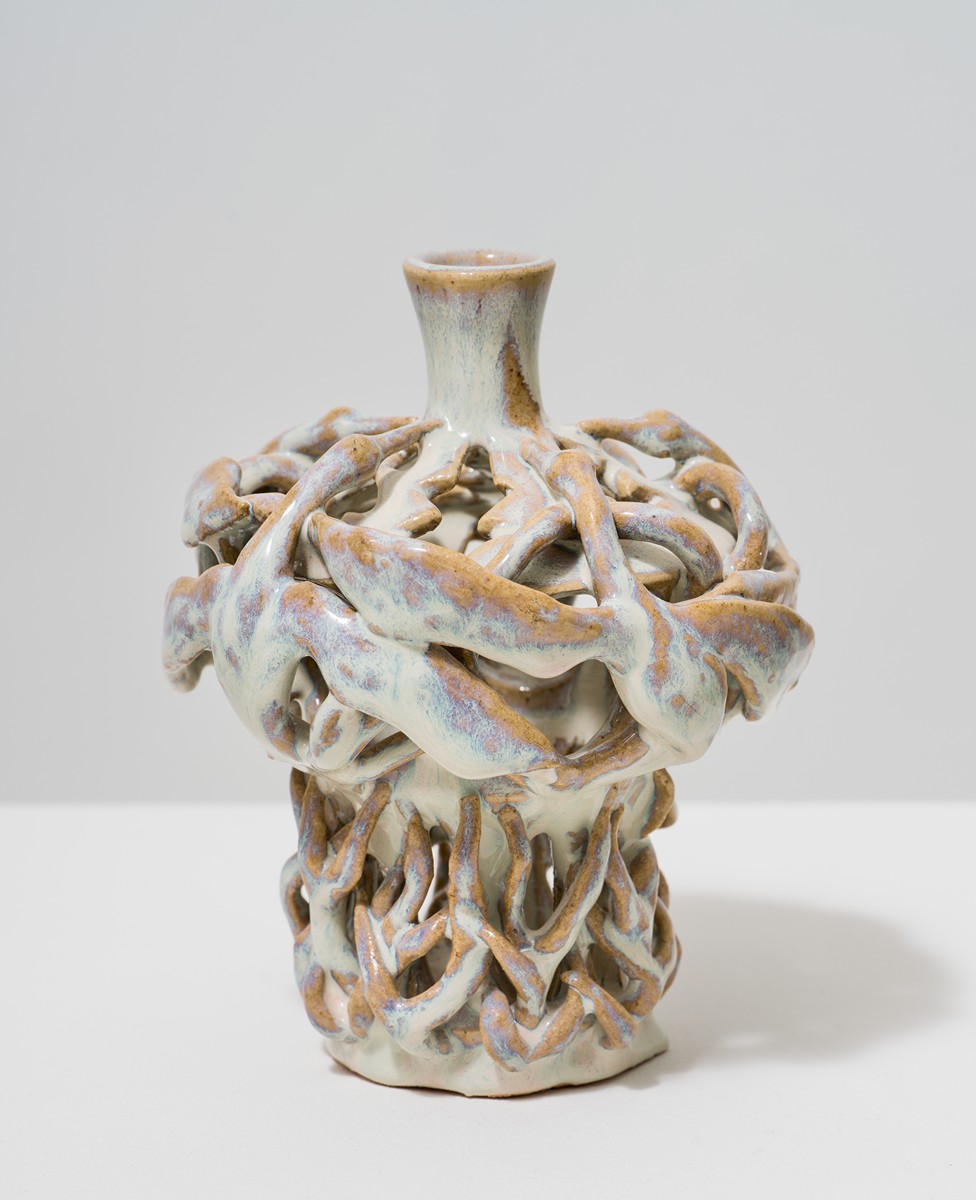
A stay in South Korea proved decisive for the artist. There she was able to free herself from the pressure to produce in volume that she had been used to meeting until then, and could instead concentrate fully on making new work. The result is the successful vase series My Name is Dragon, in which Hnízdilová turns to the ancient belief in the protective power of art. The vessels carry the symbolism and imagery of dragons, snakes and basilisks, creatures that appear across cultures and whose task is to guard a space against evil spirits and demons, or to frighten them off by their very appearance. It was on visits to Buddhist temples in South Korea that the artist first became interested in dragon symbolism.
In 2021 she co-founded the Hlinotéka project in Prague 7, which brings together artists who work and experiment with the material. The space houses a studio for residents to work in, a showroom presenting their pieces and an education centre offering classes in ceramic techniques.
"Another way of warding off evil spirits is mathematics. According to Gombrich, a demon can gain power over things whose number it knows. Counting, repeated elements in great quantity and uncertainty about numbers therefore also serve as a protective device. This is how we can read the meaning of interlacing and intricate knots in ancient ornament. Their accumulation is meant to charge the sacred vessel with great strength, with magical power. For according to the beliefs of many peoples, demons hate nothing more than being confused. Knots, labyrinths, interlaces and other forms of indeterminacy are thus held to be perfect protection against the evil influences that lurk all around."
Ernst Gombrich, The Story of Art
