
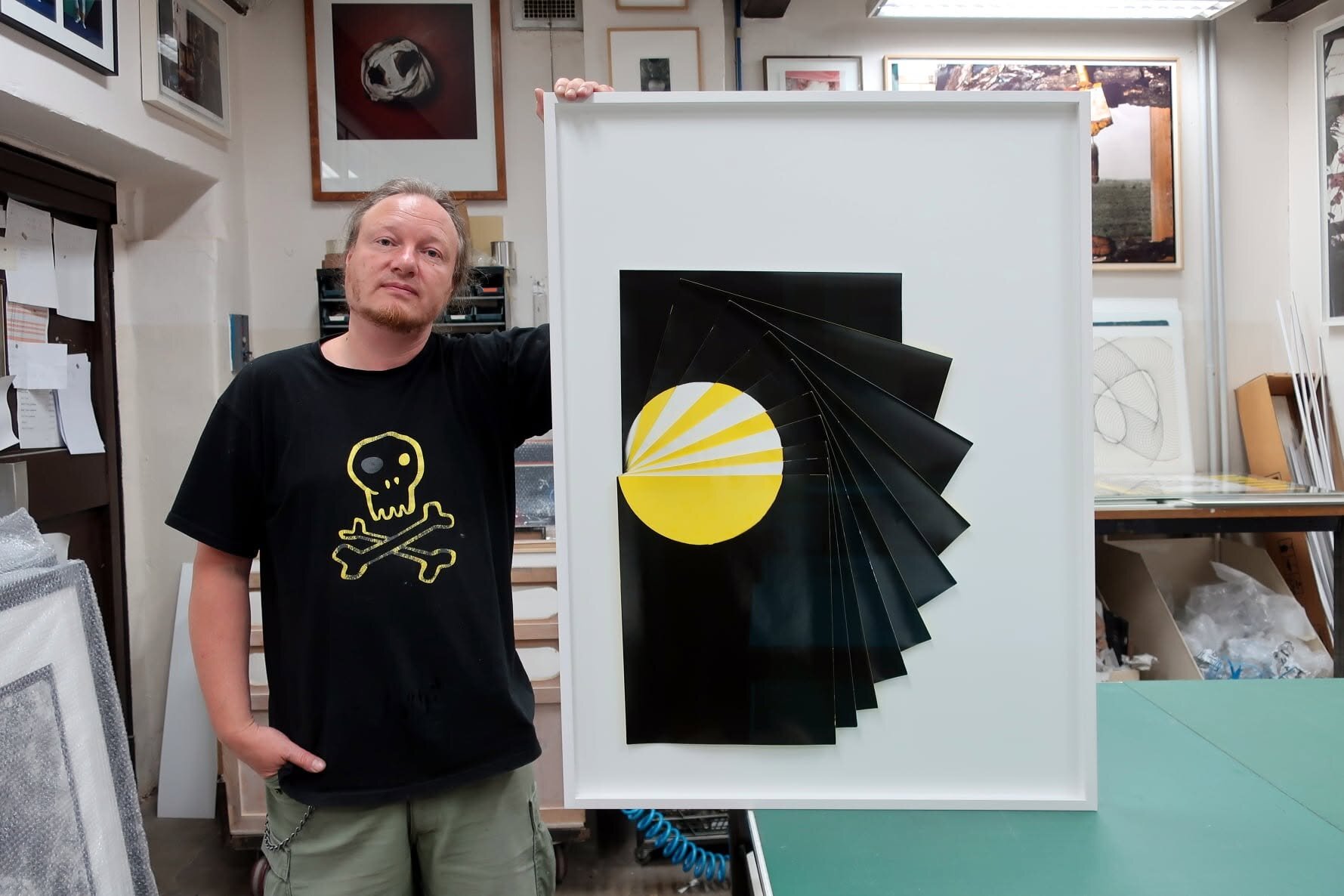
A Frame Should Not Compete with the Work: Cyrill Marounek on How Framing Can Both Protect and Devalue
Although many collectors do not give framing their primary attention, this discipline plays a very significant role not only in protecting and archiving a work, but also in substantially shaping its overall character. “Unless it is the artist’s own intention, in presenting art the work itself is more important than the frame,” says Cyrill Marounek, who together with Jiří Kadlec founded Rámy pasparty s.r.o., today one of the most sought-after framing workshops in the Czech Republic. What qualities should framing bring in terms of protecting a work, why is it not worth economising on, and how strongly can this discipline affect the impact of artworks?

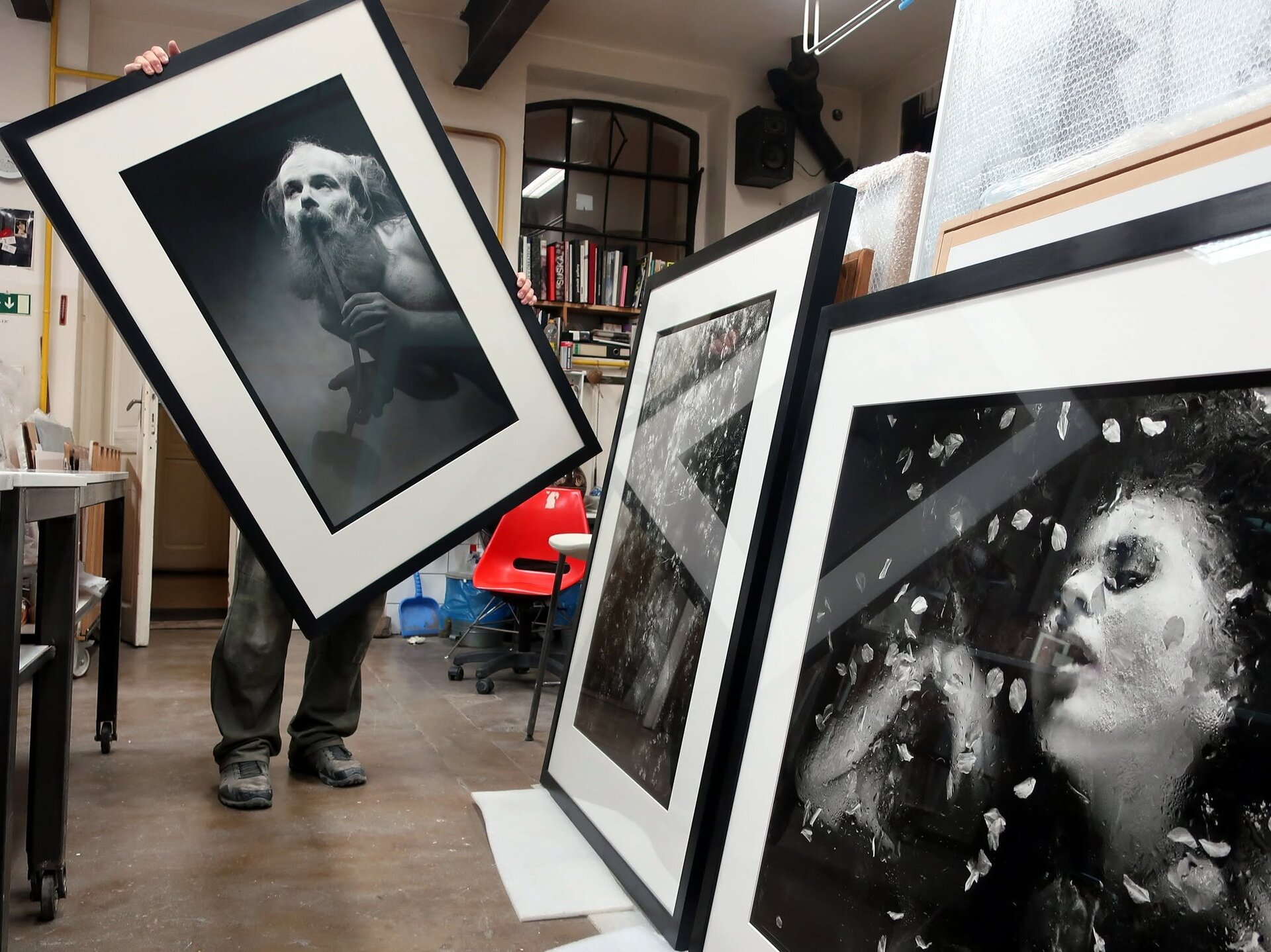
Framing artworks is not just a matter of aesthetics. How important is a well-chosen frame for the long-term protection of a work?
CYRILL: To protect a work when framing it, it is good to pay attention to three things: the pH neutrality of the board, the UV protection of the glass, and the way the work is attached to the mount or backing board. It is really important to use pH-neutral boards and adhesives that do not damage the work itself over time and that, besides good archival properties, also allow the work to be taken out of the framing and the materials removed if needed.
Quality materials, of course, come at a price, and people often weigh the price of the work against the price of the framing. That is when compromises are made to save money. But I really wouldn't cut corners on pH-neutral boards and proper mounting. We use both certified and uncertified mount boards, whose pH neutrality we have had measured by paper conservators. Their price is not that dramatic, and it is an investment that definitely pays off.
Does the mount play a role in protection too?
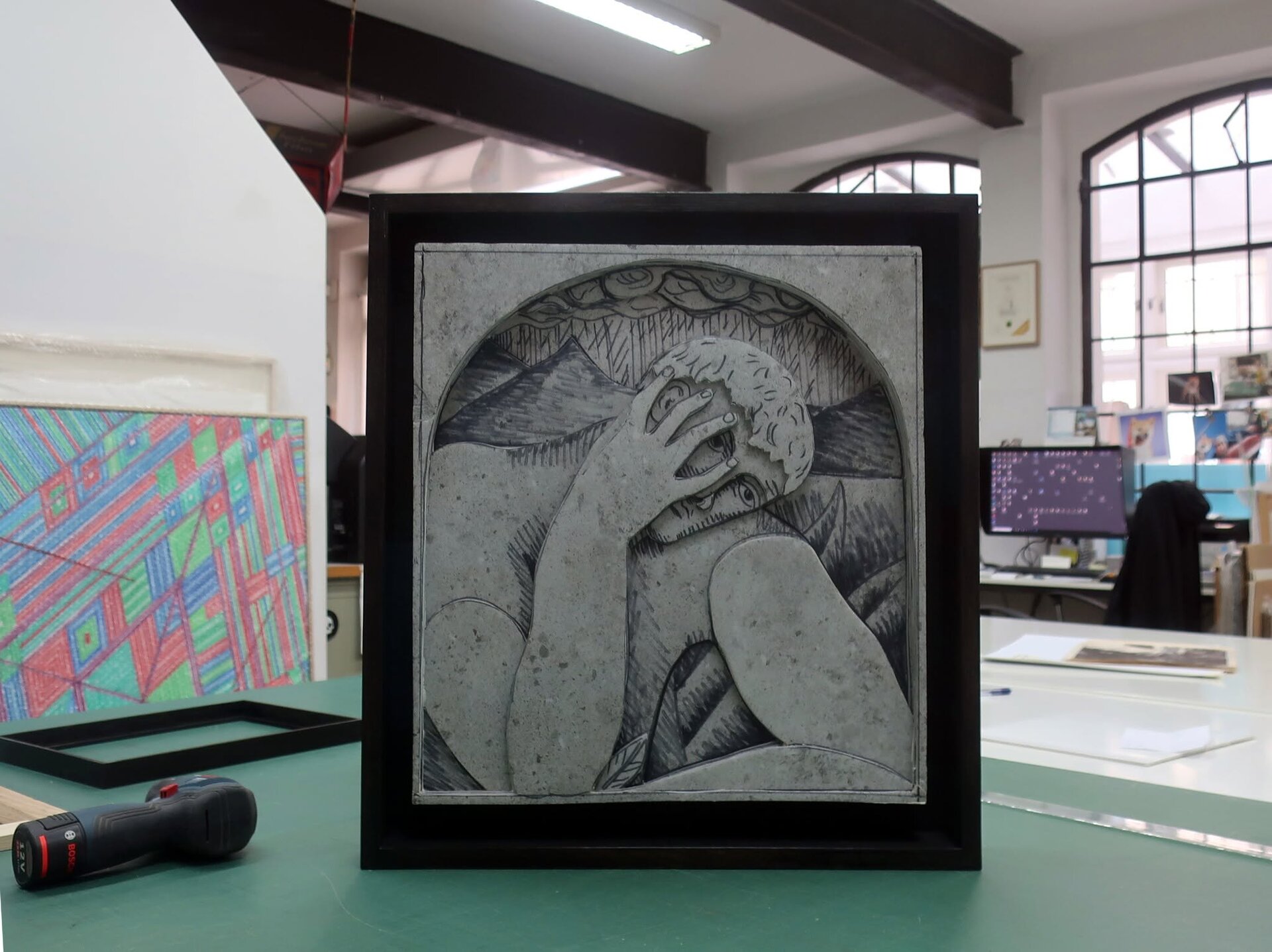
CYRILL: In this respect, the mount is beneficial above all because of the thickness of the mount board, which creates a protective air gap above the framed work. That is always better than having the glass lie directly on the work. If the framing requires the whole sheet to be shown, but we still want to keep this protective distance, we create the gap with a spacer strip inserted into the rebate of the frame. We call this a shadow box frame.
At the beginning you mentioned UV glass as an important part of protection. How does ordinary glass differ in this respect from anti-reflective and museum-grade glass?
CYRILL: Ordinary reflective glass by its nature offers roughly 35% UV protection. Anti-reflective glass is coated with a microscopic layer of metal, which minimises ordinary reflection. The type we use in large quantities has UV protection of around 70%, but from the point of view of safely archiving a work even that is not quite sufficient. Museum quality is understood to mean glass with UV protection above 97%. We have glass for which the manufacturer guarantees 99% UV protection. But again, the difference between the types of glass is not only in quality, but also in price.
In recent years you have focused mainly on framing contemporary art across a wide range of media. How do the requirements for framing drawings, prints and watercolours differ?
CYRILL: In short, some techniques don't necessarily need the highest UV protection, and for some more durable printmaking techniques, unlike drawing, pastel or watercolour, the distance from the surface of the glass may not be so important, but I definitely wouldn't underestimate pH-neutral mounts and suitable archival fixing.
Are there cases where works are not glazed and the materials still don't degrade? In which cases would you recommend this option?
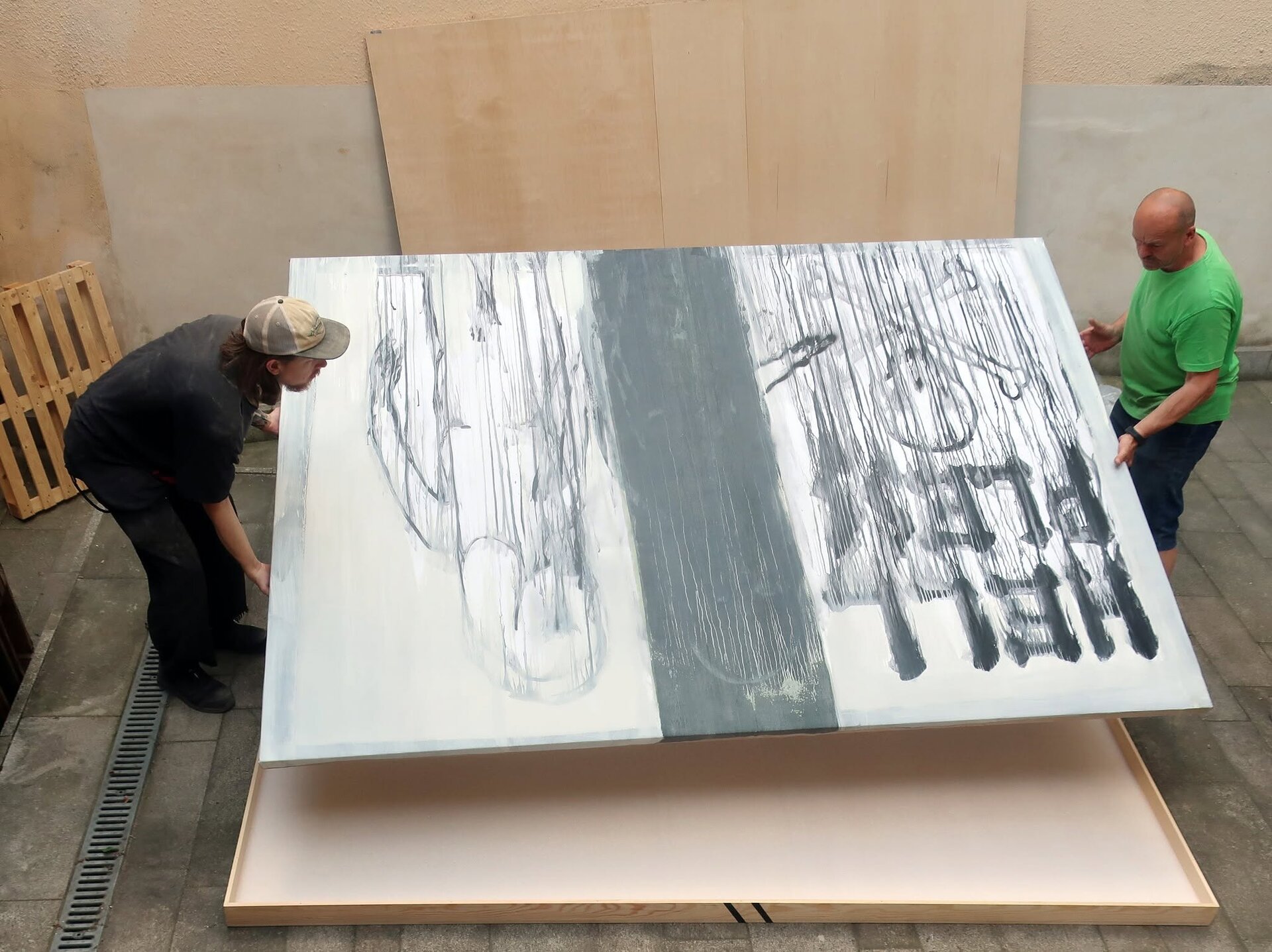
CYRILL: I would certainly recommend the unglazed option for oil or acrylic paintings. There it is not necessary, and often not even appropriate, to cover the work with glass.
What factors determine how a photograph is framed?
CYRILL: I don't see any significant difference between photography and painting, drawing or printmaking. If the artist agrees, the photograph can be fully backed with a support board or pH-neutral self-adhesive film before it is placed in a shadow box frame or mount. This is how we back, for example, photographs by Ivan Pinkava or photograms by Josef Achrer. Sometimes it is appropriate to hang a photograph in a shadow box frame so that the character of the material used is revealed. We recently framed a large photograph by Hynek Alt in this way.
Nevertheless, a classic photograph calls for classic framing. By that I mean placing it in a mount and a thin natural or black frame. This is how we frame, for example, photographs by Josef Sudek.
From an aesthetic point of view, framing can help a work considerably. But unless the artist intends otherwise, it should remain a supporting element. What principles should one follow so that the frame does not affect the basic impact of the work?
CYRILL: If the artist brings the work in for framing themselves, it's simple. They tell us how they imagine the framing, and we try to realise their vision, taking into account the technical possibilities and the functionality of the whole. I also think that a frame is a supporting element and sometimes even a "necessary evil", so it should definitely not compete with the work. That is why, in our framing, we take the path of the simplest and most subtle frames, but ones that are made to a high standard. We want it to be clear at first glance that the artist, the owner and the framer all take the work seriously.
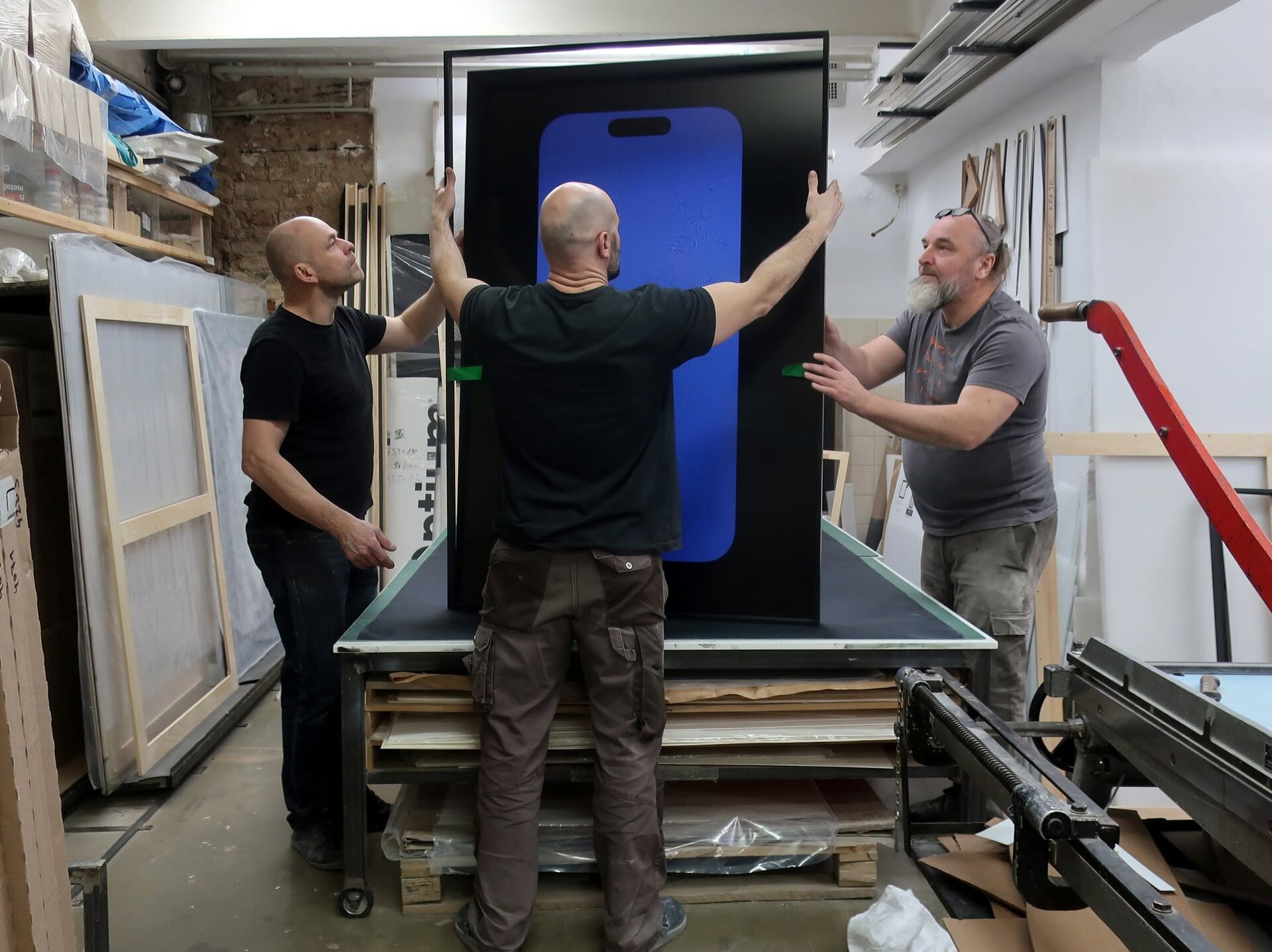
Your framing workshop on Lípová Street is now in its fifteenth year. You must have a lot of experience with unusual commissions…
CYRILL: We really have been going for a long time: before Lípová we spent 7 years in Žižkov, 2 years in Holešovice and several years in Karlín. But that was so long ago that I can't even remember how long it was…
We have had plenty of really interesting collaborations. For the artist duo David Bohm and Jiří Franta, for example, we made corner shadow box frames and multi-sided frames based on the artists' drawings. For Roman Týc we poured ash into shadow box frames, and for the photographer Dominik Hejtmánek we mounted his large photographs on laminated boards cut into organic shapes. For Krištof Kintera's assemblages we have long been making extra-deep shadow box frames that look like children's sandpits. For Tranzit Display we built a set of crates that, when unfolded, work as a mobile bookshop, and František Skála came to us with a commission for illuminated boxes with a magnifying glass, in which he presented heads made of seaweed. For Epose 257 we framed parts of billboards in lacquered shadow box frames…
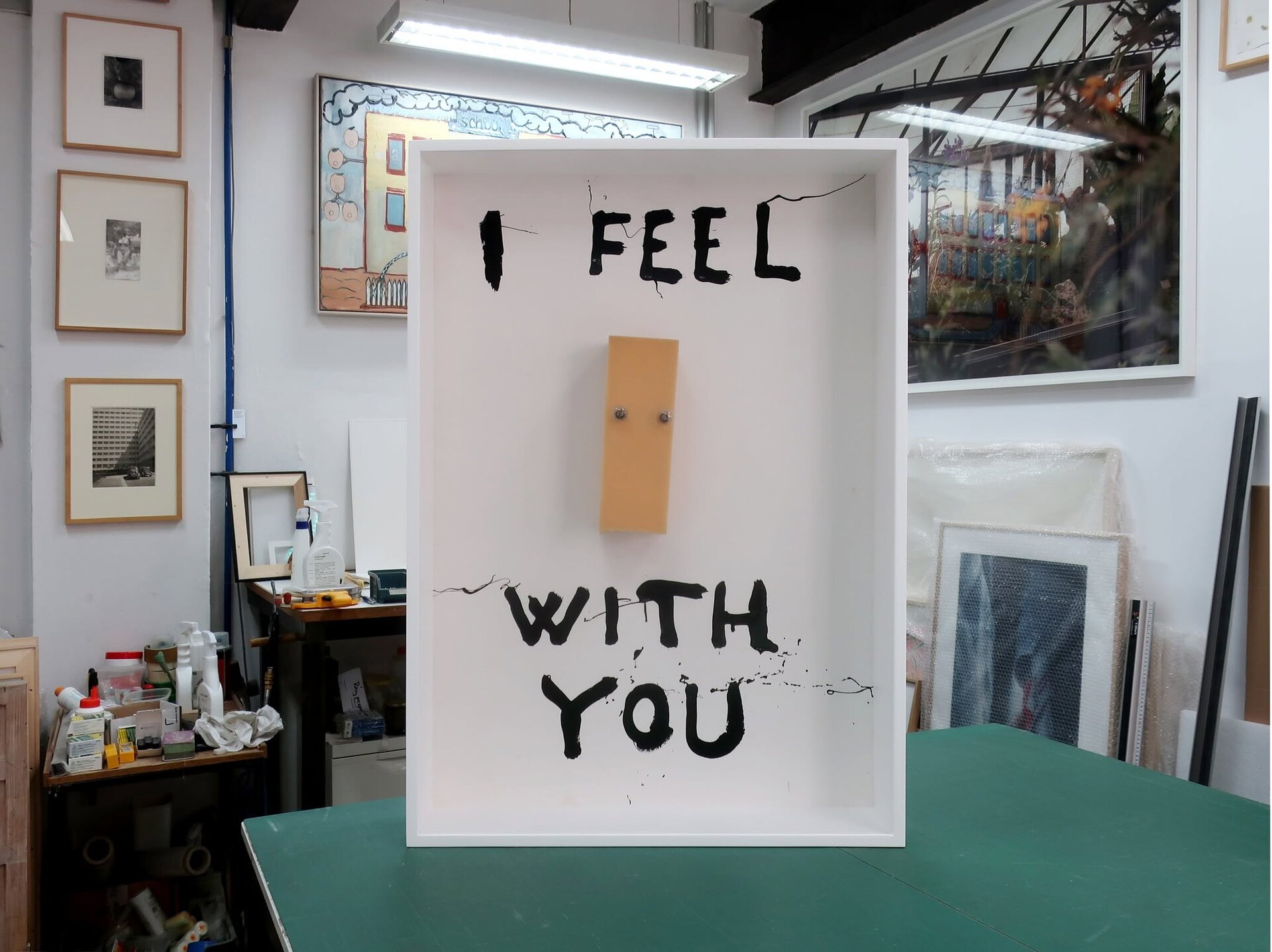
That's a solid list indeed. Which of these commissions was the biggest challenge for you?
CYRILL: That's hard to say, but one very demanding job was, for example, preparing Jiří David's presentation at the Venice Biennale, where we built a free-standing mirror wall measuring 4 × 5 m, or when we wrapped the entire Czechoslovak pavilion in a banner.
What mistakes do people commonly make when framing and mounting artworks?
CYRILL: People can make two kinds of mistake. The first, the visible one, is an attempt to embellish the work aesthetically. The exception, of course, is when the artist themselves thinks of the frame as part of the work and perhaps even finishes the frame as an artistic intervention (recently, for instance, Ján Ďurina created an artist's surface on frames we had made). A more fatal mistake is the use of unsuitable materials that are not gentle on the work, and adhesives that degrade the paper of the work and cannot be removed without trace.
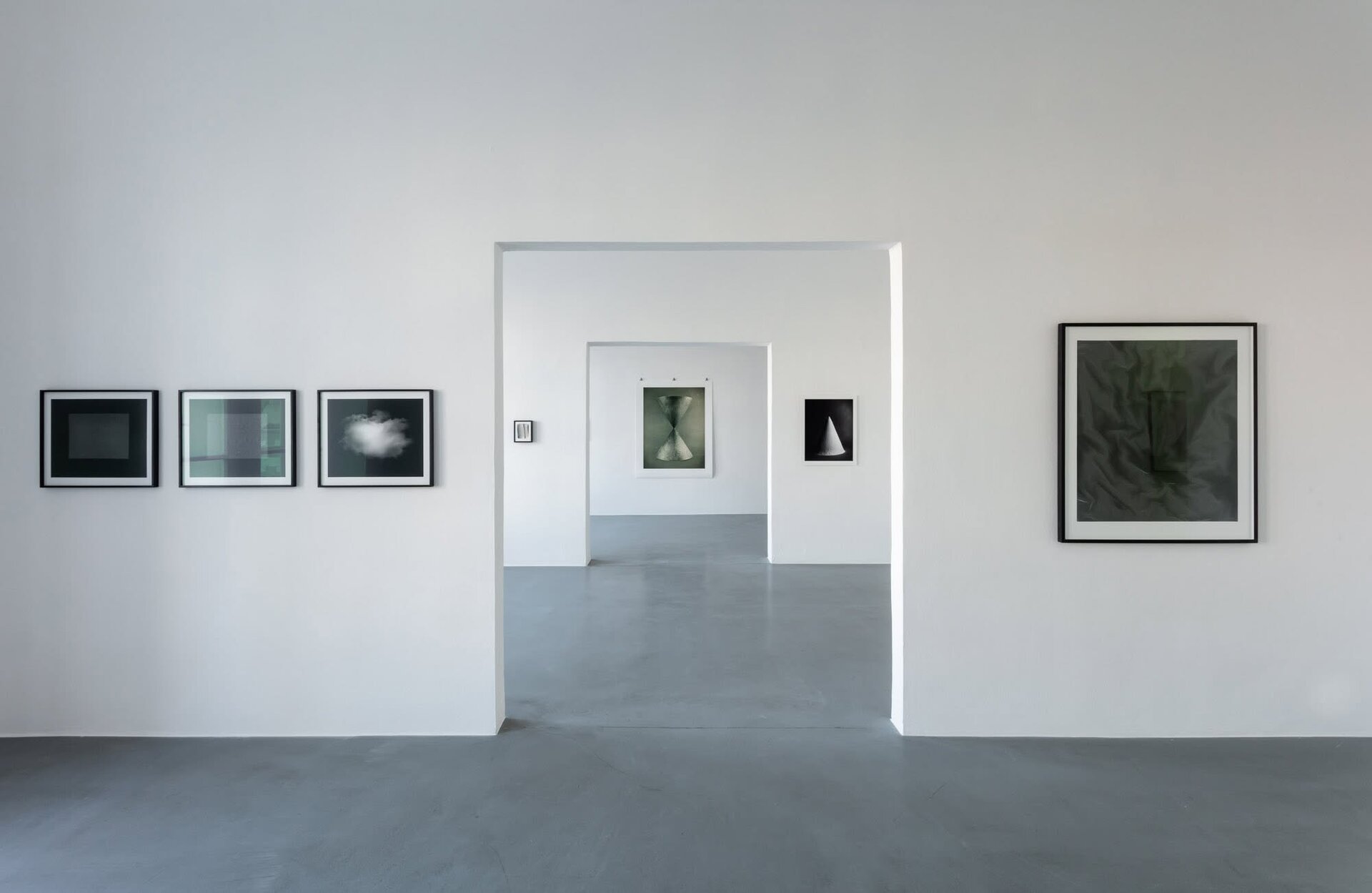
Your workshop has long followed a path of minimalism… But can any current trends be traced in framing, in your view? And are they even needed?
CYRILL: I'm not sure I'm qualified to answer that question authoritatively. Within the range of framing on offer, we have found our place in functionality and minimalism, because we believe that in presenting art, the work itself is more important than the frame. We stick to that and develop our work with this intention.
What would you like every collector to know about framing before they bring you their work for the first time?
CYRILL: That they read this interview of ours. (laughs)
